
Guide · Tools
Best A/B Testing Tools for Growth Teams (2026)
A/B testing tools compare page variants against a control.
But the tools themselves have split into camps that barely resemble each other. Enterprise platforms that assume an engineering-led program. Marketer suites with visual editors. Open-source engines that live in your data warehouse. Product experimentation tools built around feature flags. And a newer camp, where we sit, that treats testing as something the software should mostly do for you. Buy from the wrong camp and you’ll spend a year fighting the tool instead of running tests.
This guide ranks 8 A/B testing tools by what they actually do and who they fit. One disclosure up front: we ranked our own product first, and the entry explains exactly why and when you shouldn’t pick it. If you’re shopping the broader stack (page builders, personalization, analytics), see our ranking of the best conversion rate optimization tools. This one is just about testing.
By Tailor AI team · Last updated July 20, 2026
 Tailor AI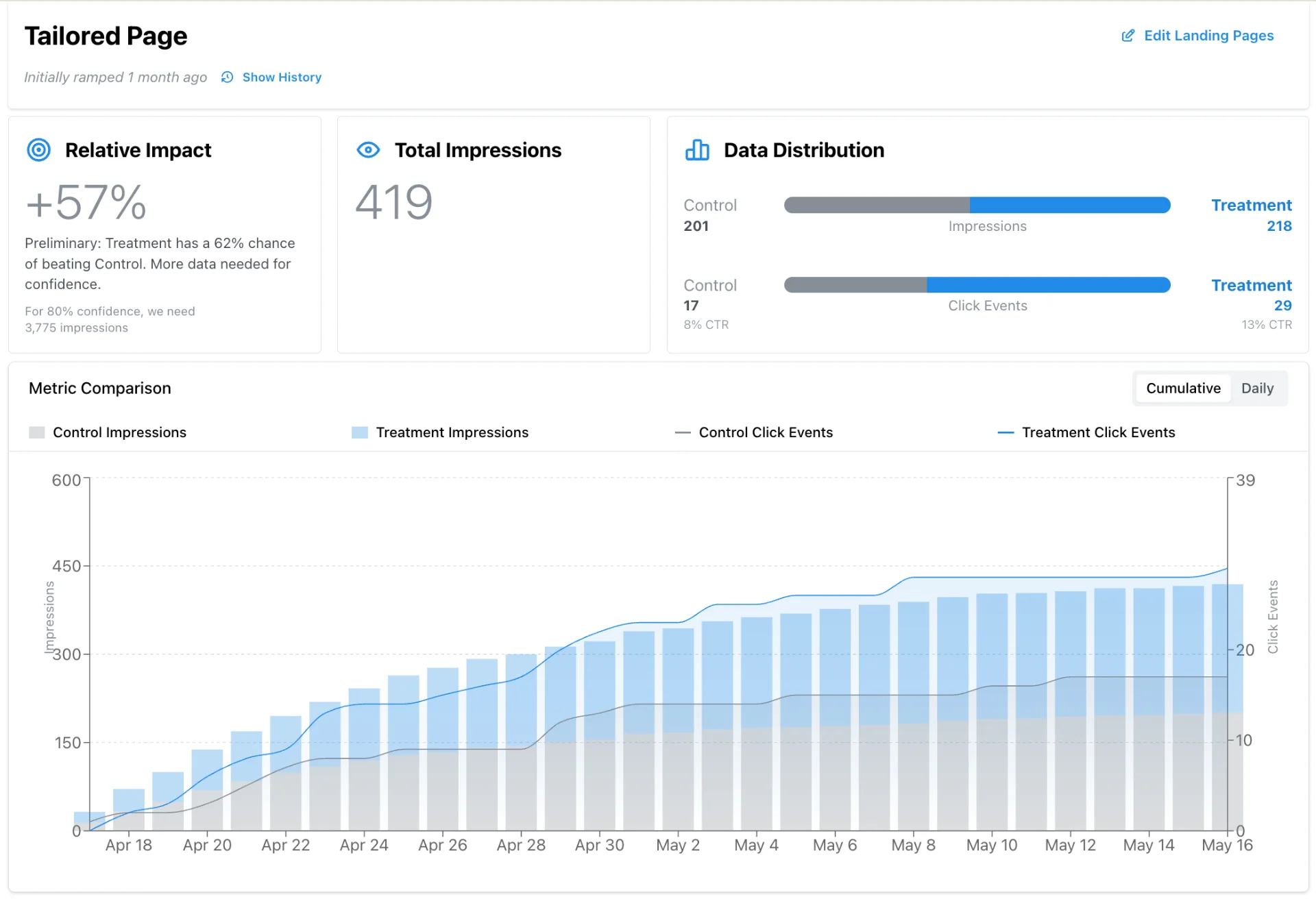
- Who this is for
- Growth and performance marketing teams that want more experiments live on their site, with results they can defend, and without every test becoming an engineering ticket.
- Methodology
- Claims come from primary vendor pages and documentation. No review scores, no pricing numbers, no invented stats. If a capability isn't explicit on the vendor site, treat it as verify, not true.
Teams running Tailor






TL;DR
The short answer
- If you want tests found, built, and launched for you, with testing proving every change → Tailor AI
- If you run an enterprise, engineering-led experimentation program → Optimizely
- If you want marketer-run testing plus behavior analytics in one suite → VWO
- If you want experimentation plus personalization with strong EU support → AB Tasty
- If you need a focused, privacy-first testing engine and bring your own program → Convert.com
- If your experiments live next to product analytics and engineers run them → PostHog
- If you want open source and stats computed on your own warehouse → GrowthBook
- If you're testing inside the product with feature gates, not on the marketing site → Statsig
The full entries below cover what each tool actually is, where it wins, and where it doesn’t.
Context
Why classic A/B testing tools stall for most teams
Check whether each variant can receive enough conversions for a useful test.
“The process of A/B testing is very slow for me because we don’t have much traffic. So it’s not that I can change it every week or two. Each time I can only update, change one thing.”

Evaluate traffic requirements and the work needed to build each test.
That’s the lens for the ranking below. If you have serious traffic, almost any tool here will serve you. If you don’t, the interesting question is which tool changes the math instead of just running the slow version faster. Our traffic thresholds guide covers how to size what your volume can actually support.
Criteria
Six questions we asked of every tool
These are the same questions worth asking on any sales call. They separate the tools quickly.
- 1
Who designs and builds the tests: your team, or the tool?
- 2
Can it test per segment (campaign, keyword, geo, device, company), or only site-wide?
- 3
Does measurement stop at clicks and form fills, or reach trials, pipeline, and revenue?
- 4
How honest is the stats engine: does it guard against peeking and false winners?
- 5
What does the script do to page speed, Core Web Vitals, and what search engines see?
- 6
How much engineering does it take to go from install to first live test, honestly?
Ask who will propose and build the tests.
The list
The 8 best A/B testing tools, ranked
The order reflects fit for the audience of this guide: growth teams with real paid spend and limited engineering support. An enterprise experimentation lead or a product engineering team would order this list differently, and the entries say so where it applies. Every tool here’s a credible product; none of them is the right answer for every team.
1.Tailor AI
tailorhq.ai ↗Automatic site personalization with testing built in
- What it is
- First, the honest framing: Tailor isn't an A/B testing tool. It's automatic site personalization and optimization. It researches visitor intent per segment (campaign, keyword, audience, geo, enriched company and role), proposes the changes worth making, builds the variants, and launches them on your approval. A/B testing is built in because it's how every change proves itself: nothing Tailor ships is assumed to work, it's measured against control, per segment.
- Strengths
- It attacks the part of testing that testing tools leave to you: deciding what to test, building it, and keeping a cadence going. Marketers edit live pages directly in the browser, so there’s no dev queue between idea and live test. Results tie to downstream metrics like trials, pipeline, and revenue rather than stopping at clicks. Because it works per segment, it finds wins that site-wide tests average away, which matters most on the low-traffic pages where classic testing stalls. The script loads asynchronously, doesn’t change what search engines see, and doesn’t affect your Lighthouse score.
- Limitations
- If what you want is only a testing engine, a neutral referee for tests your team designs, pick a dedicated one from this list; that's not what Tailor is for. It also isn't a feature-flag platform for experiments inside a logged-in product (that's Statsig or GrowthBook territory), and it isn't built for enterprise governance workflows. It earns its keep fastest when paid traffic is a real line item.
- Best for
- Growth teams at companies spending on paid acquisition that want the whole loop handled (find, build, launch, prove) rather than another tool that waits for them to design tests.
2.Optimizely
www.optimizely.com ↗Enterprise experimentation platform
- What it is
- Optimizely is the reference platform for enterprise experimentation. Web experimentation, feature experimentation, and feature flags in one system, with a stats engine and program management built for organizations that treat testing as a formal discipline.
- Strengths
- Depth and rigor. Multivariate tests, server-side experiments, flags tied to rollouts, and governance across many teams. The stats engine is a genuine strength: it's designed to let you look at results as they come in without inflating false positives, which matters more than most buyers realize. For engineering-led programs at scale, it remains the standard answer.
- Limitations
- Implementation is a project, not an install. Getting value requires engineering ownership, and small marketing teams often end up using a fraction of what they pay for. If that’s the concern that brought you here, we keep a separate guide to Optimizely alternatives that maps the options by team shape.
- Best for
- Enterprise product and engineering organizations running a formal experimentation program with dedicated owners.
3.VWO
vwo.com ↗CRO suite with A/B testing at the core
- What it is
- VWO started as an A/B testing tool and grew into a suite: testing, heatmaps, session recordings, surveys, and form analytics under one roof. It's one of the longest-running names in the category and squarely aimed at mid-market marketing teams.
- Strengths
- The visual editor lets marketers build straightforward tests without code, and having research and testing in one place shortens the path from observation to hypothesis to live test. For a team buying its first serious testing platform, it's a common and reasonable pick, and the breadth means fewer vendors to stitch together.
- Limitations
- You still supply the program: ideation, prioritization, variant design, and analysis are your team’s job, so the suite gives a staffed team more surface area rather than fixing a bandwidth problem. As with any client-side tool, check script weight and flicker on your own pages. For a full side-by-side, see Tailor vs VWO.
- Best for
- Mid-market teams with someone who owns CRO and wants testing plus behavior analytics from a single vendor.
4.AB Tasty
www.abtasty.com ↗Experimentation and personalization suite
- What it is
- AB Tasty combines experimentation and personalization in one marketer-facing suite, with a library of ready-made widgets for common conversion plays. It also offers feature experimentation for product teams, and it has particular strength in Europe, where much of its customer base and support presence sits.
- Strengths
- Testing and personalization in one tool marketers can run themselves. The pattern library shortens the path from idea to live test for common cases like banners, social proof, and urgency elements. EU teams get data-residency and support conversations that US-first vendors handle less smoothly.
- Limitations
- Rolling it out feels enterprise: onboarding, tiers, and a sales process. The personalization side still depends on your team supplying the segmentation logic and the ideas, so it extends a staffed program rather than substituting for one. Check what's in your tier before comparing.
- Best for
- Mid-market and enterprise marketing teams, especially in Europe, that want experimentation and personalization from one vendor.
5.Convert.com
www.convert.com ↗Focused, privacy-first A/B testing
- What it is
- Convert.com is a focused A/B testing tool that leads with privacy. It positions itself for teams and agencies that need GDPR-conscious testing, with careful attention to flicker control and account structures that agencies running many client programs tend to like.
- Strengths
- Focus. It does testing, does it carefully, and doesn't try to sell you six adjacent modules. The privacy posture is a genuine differentiator for European traffic and regulated industries. If you know exactly what a testing engine should do and just want one that does it well, this is the profile.
- Limitations
- You bring the entire program: research, ideation, variant building, and analysis stay with your team. Personalization is lighter than in dedicated engines, so segment-specific experiences aren't the core play. It's a dependable referee, not a co-pilot.
- Best for
- Agencies and privacy-sensitive teams that have their own testing process and want a dependable engine under it.
6.PostHog
posthog.com ↗Product analytics with experimentation
- What it is
- PostHog is a product analytics platform (events, funnels, session replay, feature flags) that includes experimentation as one of its tools. It's self-serve and developer-led: you instrument your product, and experiments run against the same event data everything else uses.
- Strengths
- If your engineers already use PostHog for analytics, experimentation is right there, wired to the metrics you already trust, with no separate integration to maintain. The free tier is famously generous (verify current terms on their site), which makes it an easy way for a product team to start testing without a procurement cycle.
- Limitations
- It's built for people comfortable instrumenting code. Marketers won't be visually editing the homepage here; experiments generally mean engineering work, and marketing-site use cases like campaign-level message match are outside its center of gravity. It's a product experimentation tool that happens to be adoptable, not a marketing testing suite.
- Best for
- Product and engineering teams already on PostHog analytics who want experiments against the same event data.
7.GrowthBook
www.growthbook.io ↗Open-source feature flags and experimentation
- What it is
- GrowthBook is an open-source platform combining feature flags and experiment analysis. Its distinctive move is being warehouse-native: instead of collecting your data, it computes experiment results directly against the data warehouse you already have.
- Strengths
- The warehouse-native model means your experiment metrics are your real metrics, not a copy in a vendor's database, and data teams can audit every calculation. Open source means you can self-host, which solves procurement and privacy conversations at once. For teams with a real data stack, it's one of the most credible architectures in the category.
- Limitations
- It assumes a data-mature team. You need a warehouse, defined metrics, and engineers to wire flags into the codebase; there's no visual editor workflow for a marketer to test a headline this afternoon. The tool is honest about this, but buyers sometimes aren't honest with themselves about it.
- Best for
- Engineering and data teams that want open source, warehouse-native experiment stats, and full control of the stack.
8.Statsig
www.statsig.com ↗Product experimentation and feature gates
- What it is
- Statsig is a product experimentation platform built around feature gates: every rollout can be an experiment, with automated impact measurement on the metrics you define. It came out of the large-scale experimentation culture at big tech companies and is aimed squarely at engineering teams.
- Strengths
- The gate-first model is the draw: shipping and testing become the same motion, so experimentation happens as a side effect of releasing features instead of as a separate program someone has to run. The stats tooling is serious, and engineers tend to like how little ceremony sits between code and measured rollout.
- Limitations
- It's last on this list only because it's furthest from this guide's audience. Statsig lives inside the product, wired into your codebase by engineers. Marketing-site testing, campaign message match, and marketer-run workflows aren't what it's for. For a product engineering team, it would rank near the top.
- Best for
- Engineering teams that want every feature rollout measured as an experiment inside the product.
Curious if Tailor fits your team?
Summary
A/B testing tools compared
The same eight tools in one view. The categories blur at the edges (most suites include some personalization, most product tools include flags), so treat the operating model column as the real differentiator. Based on primary vendor documentation; verify against your requirements before buying.
| Tool | Category | Operating model | Best for |
|---|---|---|---|
| Tailor AI | Automatic site personalization with testing built in | AI finds, builds, and launches tests per segment on your approval | Growth teams with paid spend that want tests run for them, not just hosted |
| Optimizely | Enterprise experimentation | Engineering-led program with feature flags and governance | Enterprise experimentation orgs with dedicated owners |
| VWO | CRO suite | Marketer-run testing plus behavior analytics modules | Mid-market teams consolidating testing and research tools |
| AB Tasty | Experimentation + personalization | Marketer-led suite with a pattern library, strong EU presence | Mid-market and enterprise marketing teams, especially in Europe |
| Convert.com | Focused A/B testing | Privacy-first testing engine; you supply the program | Agencies and privacy-sensitive teams with their own process |
| PostHog | Product analytics with experimentation | Self-serve, developer-led; experiments live next to analytics | Product and engineering teams already using PostHog analytics |
| GrowthBook | Open-source experimentation + feature flags | Warehouse-native stats; self-host or cloud | Data-mature teams that want experiments computed on their own warehouse |
| Statsig | Product experimentation | Feature gates and experiments wired into product releases | Engineering teams testing inside the product, not the marketing site |
Tailor AI
- Category
- Automatic site personalization with testing built in
- Operating model
- AI finds, builds, and launches tests per segment on your approval
- Best for
- Growth teams with paid spend that want tests run for them, not just hosted
Optimizely
- Category
- Enterprise experimentation
- Operating model
- Engineering-led program with feature flags and governance
- Best for
- Enterprise experimentation orgs with dedicated owners
VWO
- Category
- CRO suite
- Operating model
- Marketer-run testing plus behavior analytics modules
- Best for
- Mid-market teams consolidating testing and research tools
AB Tasty
- Category
- Experimentation + personalization
- Operating model
- Marketer-led suite with a pattern library, strong EU presence
- Best for
- Mid-market and enterprise marketing teams, especially in Europe
Convert.com
- Category
- Focused A/B testing
- Operating model
- Privacy-first testing engine; you supply the program
- Best for
- Agencies and privacy-sensitive teams with their own process
PostHog
- Category
- Product analytics with experimentation
- Operating model
- Self-serve, developer-led; experiments live next to analytics
- Best for
- Product and engineering teams already using PostHog analytics
GrowthBook
- Category
- Open-source experimentation + feature flags
- Operating model
- Warehouse-native stats; self-host or cloud
- Best for
- Data-mature teams that want experiments computed on their own warehouse
Statsig
- Category
- Product experimentation
- Operating model
- Feature gates and experiments wired into product releases
- Best for
- Engineering teams testing inside the product, not the marketing site
Decision framework
How to choose an A/B testing tool
Choose the tool that addresses the work delaying your experiments.
- We have test ideas but they die in the dev queue.
- Your constraint is build and launch, not measurement. Tailor removes the queue by building variants itself and letting marketers edit live pages directly. Visual editors in VWO or AB Tasty help for simple changes, but structural tests will still land in the queue.
- We have a testing process and just need a trustworthy engine.
- Buy focused. Convert if privacy matters and agencies are involved, VWO if you also want behavior analytics, Optimizely if the program is enterprise-scale and engineering-led.
- Our engineers run experiments inside the product.
- That's product experimentation, a different aisle. Statsig if you want feature gates as the default motion, GrowthBook if you want open source and warehouse-native stats, PostHog if experiments should live next to your product analytics.
- We don't have enough traffic for tests to conclude.
- No engine fixes this; it's math, not software. Test bigger swings, test per segment where effects are larger, or use a tool that lowers the cost per attempt so you can run many small tests. Read the traffic thresholds guide before buying anything.
- We win tests but can't show it mattered to revenue.
- Your gap is measurement depth, not testing capacity. Pick a tool that connects variants to downstream outcomes (trials, pipeline, revenue), or wire your current one into the CRM before running another test. Our guide on measuring to pipeline covers how.
Check whether your team also needs help proposing, building, and measuring tests.
Watch-outs
Five mistakes teams make when buying A/B testing tools
- 1
Buying testing capacity when the constraint is ideas or build bandwidth.
Count the tests your team actually shipped last quarter. If the answer is one or two, more engine won't help; the bottleneck is generating and building tests, and that's what you should be buying.
- 2
Peeking at results and calling winners early.
Checking a running test daily and stopping the moment it crosses significance is how teams ship false winners. Either use a tool whose stats engine is built for continuous monitoring, or set the sample size up front and don't touch it.
- 3
Declaring winners on clicks and form fills.
A variant that lifts form submissions but attracts lower-quality leads costs you revenue while looking like progress. Wire testing into downstream data before the first test, not after the first suspicious result. Our guide to measuring tests beyond clicks walks through the setup.
- 4
Testing site-wide when the effect is per segment.
A headline that wins for one campaign and loses for another averages out to nothing in a site-wide test. You conclude the change doesn't matter when it matters twice, in opposite directions. Segment first, then test, sized to what each segment's volume supports.
- 5
Ignoring what the snippet costs you.
Client-side testing scripts can add flicker or block rendering, and a slow page depresses the very conversion rate you're testing. Try the vendor snippet on a staging page and compare Core Web Vitals before and after. Ask every vendor what their script does to LCP.
Positioning
Why Tailor is ranked first (and when it should not be)
Here are our reasons for ranking Tailor first and the situations where another tool fits better.
Tailor is automatic site personalization and optimization. Testing is built in because it’s how every change earns its place: each variant Tailor proposes and launches is measured against control, per segment, down to trials, pipeline, and revenue. We rank it first because for the audience of this guide, growth teams with paid spend and thin engineering support, the thing that kills testing programs isn’t the engine. It’s the empty pipeline of tests, the dev queue, and results nobody can tie to revenue. Tailor is the only tool on this list built to remove those, and the testing that comes with it is real testing, not a demo feature.
And here’s the flip side, stated plainly: if what you want is only a testing engine, a neutral referee for experiments your team designs and builds, you should buy a dedicated one. Convert, VWO, or Optimizely will fit that job better than Tailor will, because that’s the job they’re built for. If your experiments live inside the product behind feature flags, Statsig or GrowthBook is the right aisle entirely. Rankings are only useful relative to a constraint, which is why the framework above matters more than the order of this list.
Deep dives
Full side-by-side comparisons
Operating models, targeting, where each wins, and questions to ask on the sales call.
FAQ
Frequently asked questions
Honest answer: it depends on your bottleneck. If your team designs its own tests and just needs an engine, a dedicated tool like Convert, VWO, or Optimizely is the right buy. If the real constraint is deciding what to test and getting variants built and launched, Tailor is built for that: it proposes tests per segment, builds the variants, and launches on your approval, with A/B testing built in so every change proves itself. Teams that want only a testing engine should pick a dedicated one.
Yes. GrowthBook is open source, so you can self-host the full platform. PostHog is known for a generous free tier that includes experimentation. Both are real options, not crippled trials, though free usually means your team supplies the setup, the stats review, and the maintenance. Verify current terms on the vendor sites before planning around them, since tiers change.
A classic A/B test needs enough conversions per variant to reach significance, which for most pages means hundreds of conversions, not hundreds of visitors. That is why low-traffic teams stall: each test takes months, so they run a handful per year. If your pages convert fewer than a few hundred visitors a month, prioritize bigger swings over button-color tweaks and read our traffic thresholds guide before committing to a heavy testing program.
A/B testing tools show every visitor the same candidate variants and measure which one wins overall. Personalization tools show different experiences to different segments (campaign, geo, device, company) in the first place. The categories are converging: the interesting question for a segment is not which variant wins on average but which wins for them. Tools like Tailor combine the two, personalizing per segment and using built-in testing to prove each change.
They can. Client-side testing scripts add weight, and badly loaded ones cause flicker or block rendering, which hurts Core Web Vitals and can depress the conversion rates you are trying to lift. Google has said A/B testing done properly does not hurt rankings, but cloaking or leaving redirect tests running forever can. Check how each vendor's snippet loads before buying. Tailor loads asynchronously, does not change what search engines see, and does not affect your Lighthouse score.
Depends on the tool. Visual-editor tools like VWO, AB Tasty, and Convert let marketers build simple tests without code, though anything structural usually still lands in the dev queue. GrowthBook, Statsig, and PostHog assume engineers run the experiments. Optimizely sits in between but rewards engineering ownership. Tailor removes most of the queue by building the variants itself and letting marketers edit live pages directly in the browser.
The traffic question deserves more than a paragraph. See our guide to traffic thresholds for testing before committing to a testing program.
Sources
What this guide is based on
- Tailor AI: https://tailorhq.ai
- Optimizely: https://www.optimizely.com
- VWO: https://vwo.com
- AB Tasty: https://www.abtasty.com
- Convert.com: https://www.convert.com
- PostHog: https://posthog.com
- GrowthBook: https://www.growthbook.io
- Statsig: https://www.statsig.com
This guide is maintained. If something is wrong or outdated, email us.
See how Tailor proposes and builds tests for your approval.
Book a demo and see how Tailor turns test ideas into live, measured experiments per segment.