
Use case · Meta Ads
Ship a matching page for every Meta creative theme.
Creative teams run 20 to 150 ad variants (video, static, carousel) with different themes and audiences, but all traffic lands on the same generic page. Unlike Google Ads, Meta does not pass explicit keyword intent. That makes the landing page matching problem harder, but not impossible.
Use campaign and ad-set parameters to choose relevant page variants.
Last updated March 2026
 Tailor AI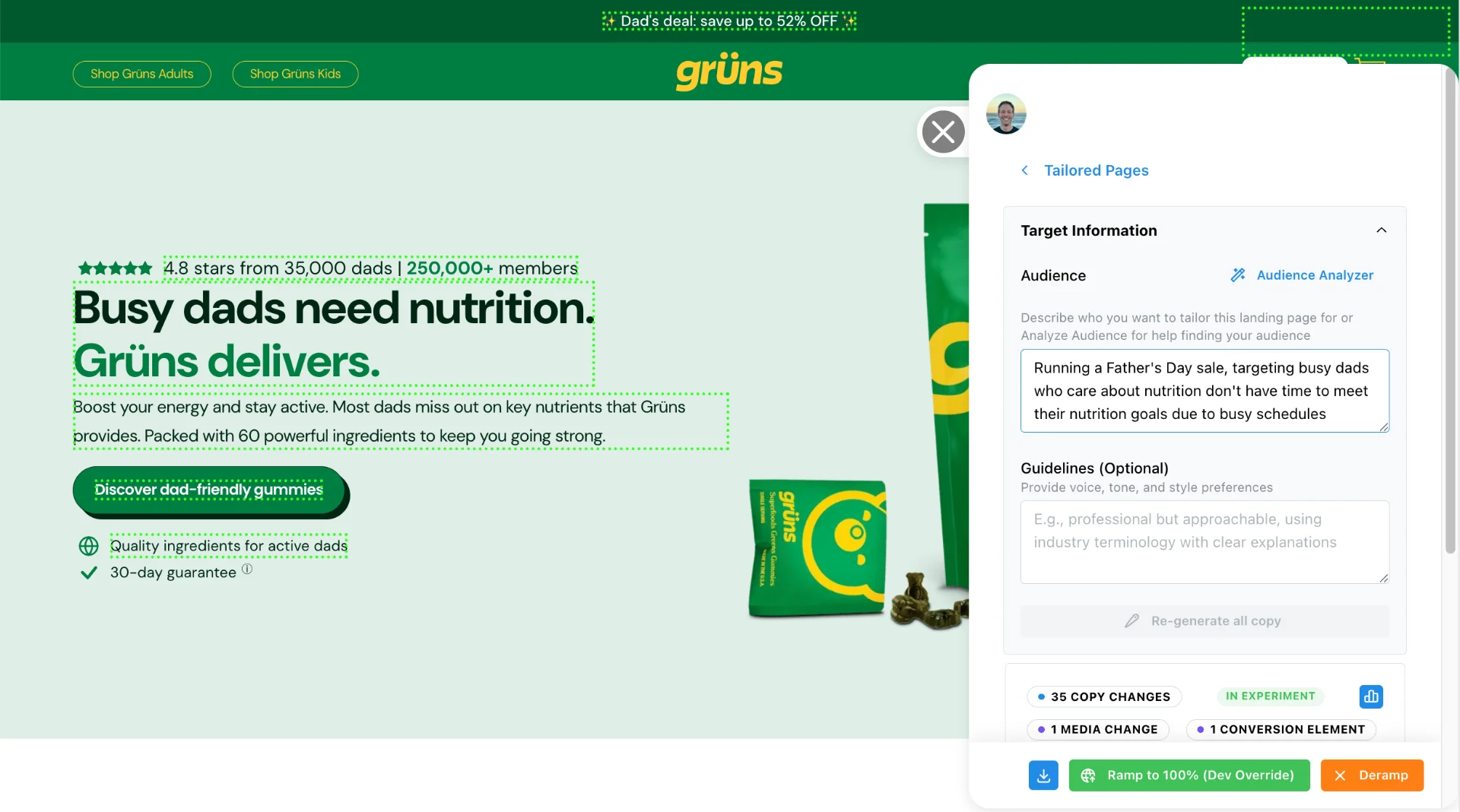
- Built from
- Hundreds of conversations with D2C and B2B teams running Meta campaigns.
- Covers
- Creative-to-page matching, Meta-specific signal patterns, and how to measure without explicit keyword intent.
Teams running Tailor






The problem
Check which creative themes need different landing page content.
Meta advertisers face a unique challenge: they run dozens or hundreds of ad concepts, but there is no keyword-level intent signal to guide the landing page. Teams run different creative for sleep, stress, anxiety, and mindfulness (for wellness), or different features (for SaaS), but send everyone to the same page.
A common pattern we hear from paid social teams:
"We have 20 to 30 ads constantly swapping creative, all pointing to the same generic page."
"Hundreds of ads, roughly... there's like one or maybe one leggings-based landing page."
"All of our static ads are going towards the same landing page but they all have different Personas."
Review landing page messaging when the ad creative changes.
How it works
Creative-to-page matching through UTM signals
Meta does not pass a keyword. But it does pass UTM parameters: campaign name, ad set name, and ad name. Those parameters carry the creative theme. Tailor reads them and adapts the page accordingly.
You can also let Tailor’s agent find the test, build the variant, and launch it. You approve before anything ships.
Since there is no keyword to match directly, you cluster by campaign and audience signals. See the full targeting guide. Common clusters include:
- Creative theme (what story the ad tells)
- Audience segment (prospecting vs retargeting, lookalike vs interest-based)
- Campaign objective (awareness, consideration, conversion)
Example: a wellness brand clusters ads into sleep, stress, and anxiety themes. When someone clicks a sleep-focused ad, the landing page shows a sleep-relevant headline and imagery. Stress clicks get stress messaging. Same URL, different experience.
Add one line of JavaScript and deploy changes instantly through a browser-based editor, with no new pages to build.
Meta-specific patterns
What makes paid social different from search
- 99% mobile traffic
- Some teams report nearly all Meta traffic on mobile. Design the adapted page for mobile first, not as an afterthought.
- Campaign/ad set level targeting
- Meta targets by audience and creative, not keywords. Your landing page signals come from campaign structure and UTM naming conventions.
- Signal dilution from geo splitting
- Breaking campaigns by geography reduces Meta's learning data per campaign. Page-level geo adaptation avoids this tradeoff, keeping campaigns consolidated while still localizing the experience.
- Creative rotation
- Review landing page variants as Meta changes the creative it serves.
- Regulated industries and targeting limits
- In regulated verticals (financial services, healthcare), Meta restricts demographic targeting. Page-level adaptation based on campaign context becomes the primary lever for relevance.
- No URL change, no learning reset
- D2C teams worry about resetting Meta's ad learnings when changing landing page URLs. Tailor adapts the existing URL in place. No new URL, no reset.
See creative-to-page matching on your site
D2C vs B2B
Same channel, different playbooks
D2C Meta campaigns
- Volume
- High. Thousands of clicks per day, many ad variants rotating.
- Key lever
- Image matching. Show the product or lifestyle image that matches the ad creative. If the ad showed a sleep product, the page should show sleep. Watch the image tailoring demo.
- Audience split
- Prospecting vs retargeting. New visitors need education. Return visitors need a faster path to purchase.
B2B Meta campaigns
- Volume
- Lower. Longer sales cycle, higher cost per click, fewer conversions to learn from.
- Key lever
- Messaging by company size, role, or industry. Often combined with enrichment data to show relevant proof points.
- Audience split
- Enterprise vs SMB, or by vertical. The same product demo request page can speak to different buying motivations.
Both benefit from per-campaign measurement. Without it, you are optimizing blind.
Measurement
Proving that creative-to-page matching works
Measure creative-matched variants by campaign and audience.
- Per-campaign and per-audience experiment results, not just page-level averages
- Measure connected purchases, trial starts, and pipeline for each experiment.
- Results show up in your existing dashboards (GA4, Amplitude), not a separate tool
- Alerting when a campaign's landing page performance drops, before spend compounds the problem
"90% of the marketers we talked to were just not doing it. They were ignoring that opportunity to carry the tailored message through the middle of the funnel."
Send experiment results to the analytics tools your team uses. Tailor fires events into the analytics stack you already use. Set up conversion goals.
FAQ
Frequently asked questions
Yes. Tailor reads UTM parameters that Meta passes when someone clicks your ad. You map campaign themes or ad sets to specific page adaptations, so each creative concept gets a matching landing experience.
No. Tailor adapts your existing page URL in place. The URL does not change, so Meta's learning data stays intact and your campaign optimization continues uninterrupted.
Tailor's adaptations are responsive by default. Since most Meta traffic is mobile, your adapted pages render correctly on mobile devices without extra work or separate mobile templates.
Yes. Map campaign names or UTM parameters to different headline, image, and CTA variations. One base page can serve multiple creative themes without building separate pages for each.
Run per-campaign experiments. Tailor tracks conversion events and ties them to downstream metrics like purchases or trial starts, viewable in GA4 or Amplitude. Results show up where your team already looks.
Match your landing page to the Meta ad creative.
See how Tailor matches your Meta ad creative to your landing page, without building new pages.
ShopBack's marketing team specified a new homepage hero, Tailor built it in the browser, and CTA clicks came back 13% up in four days.
Read the ShopBack case study