
 Tailor AIvs
 Optimizely
Optimize paid landing pages without building an enterprise experimentation program.
Optimizely offers broad experimentation, personalization, governance, and AI-assisted test creation. Tailor gives performance marketers a focused loop from paid-traffic and competitor signals to a built page variant, marketer approval, and downstream learning.
Explore the fit on a demo, or start with a site scan.
Last reviewed September 26, 2026 · Optimizely website
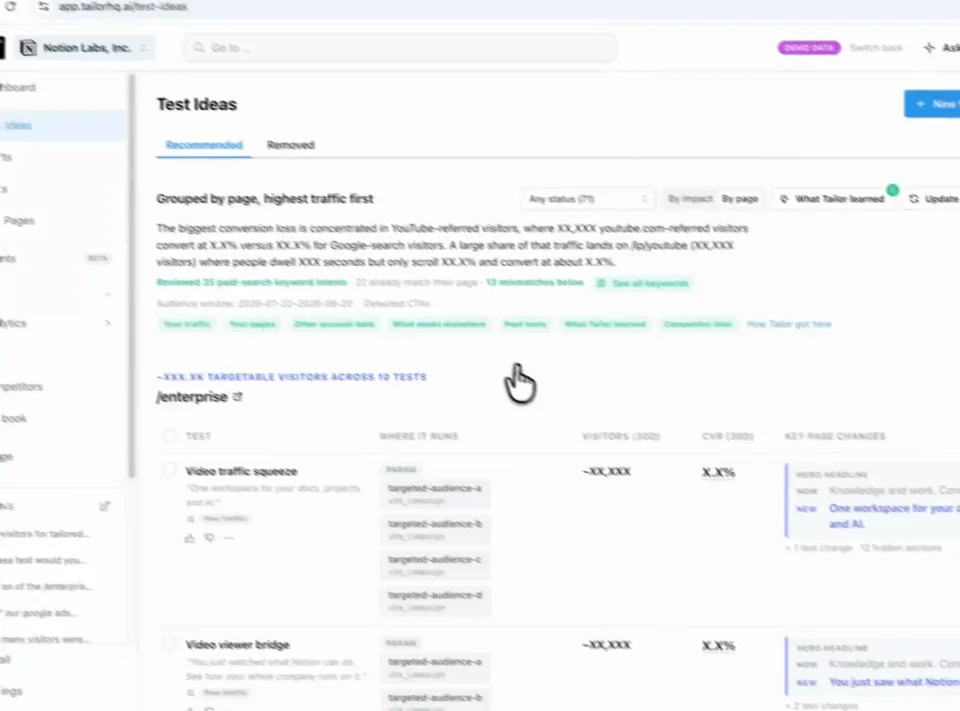
Find a test Review Approve
Teams running Tailor






Three reasons to choose Tailor over Optimizely
Keep paid-page tests moving with the team you have.
Tailor brings campaign evidence, a proposed change, and a reviewable variant into one marketer workflow.
Turn competitor changes into action.
Bring changes in competitor pages and ads together with your campaign data, then build and test your response on your existing site.
Keep the learning close to the campaign.
Measure against connected conversion goals and use the result to guide the next test for your paid traffic.
In practice · PDF Expert
You paid for the click. Make the page match the intent.
Someone searching for an Adobe alternative needs a different reason to buy than someone looking to fill a PDF. PDF Expert tested keyword-specific messaging instead of sending every search to the same generic pitch.
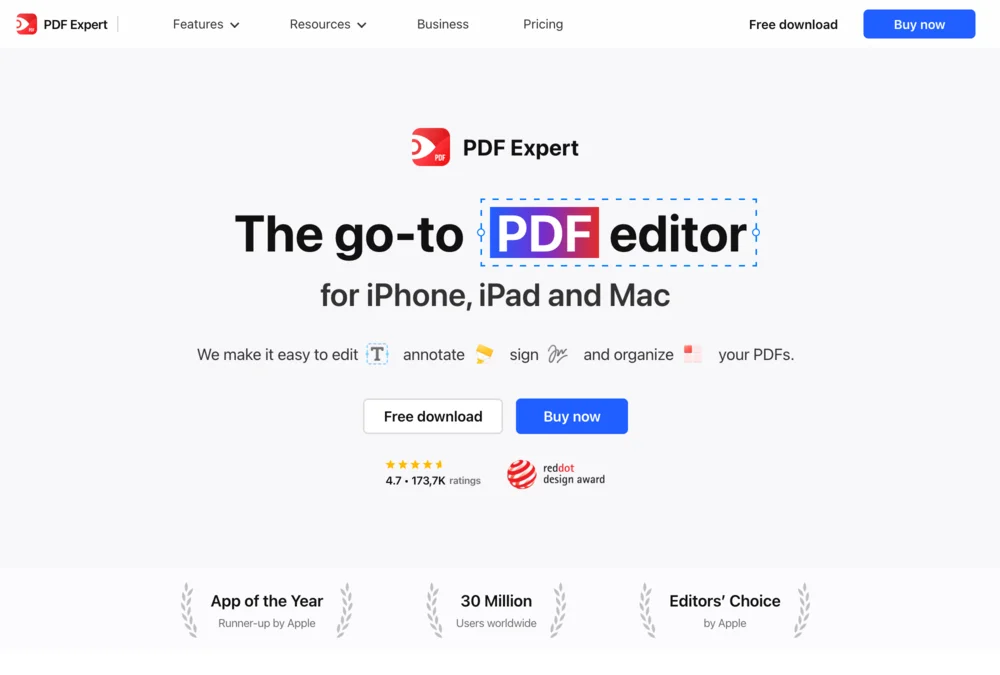
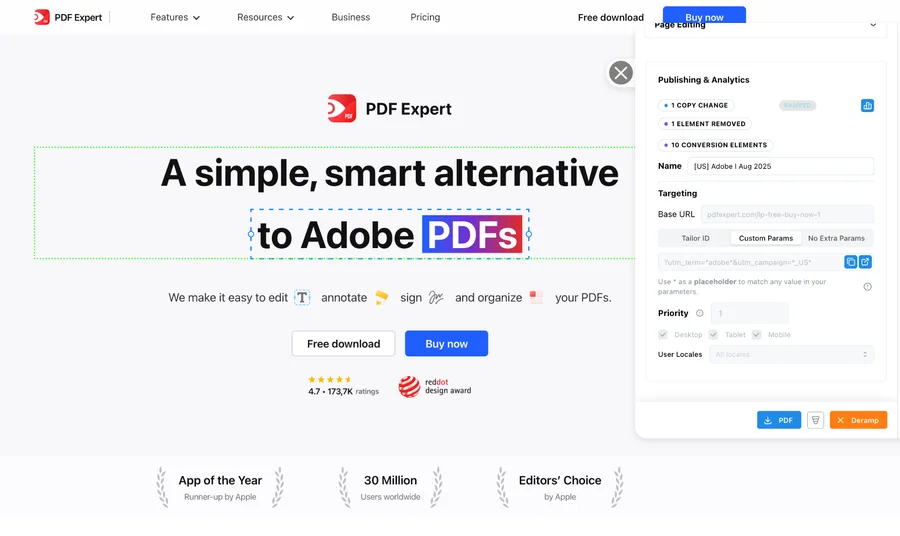
- +10%
- click-through lift for the Adobe variation shown above
- 5 minutes
- reported setup per keyword-specific page variation
- 20+
- keywords tested simultaneously in the program
The learning was specific: some keyword and region combinations improved; others did not. Testing showed where tailoring helped. These are this customer’s reported results, not a forecast for your site.
See the tests and resultsFrom signal to shipped test
Know what to test. Get it ready to launch.
Tailor monitors competitor pages and ads, combines those signals with your campaign data, and recommends tests for your site. It builds the variant for your review, measures the result, and carries the learning into what comes next.
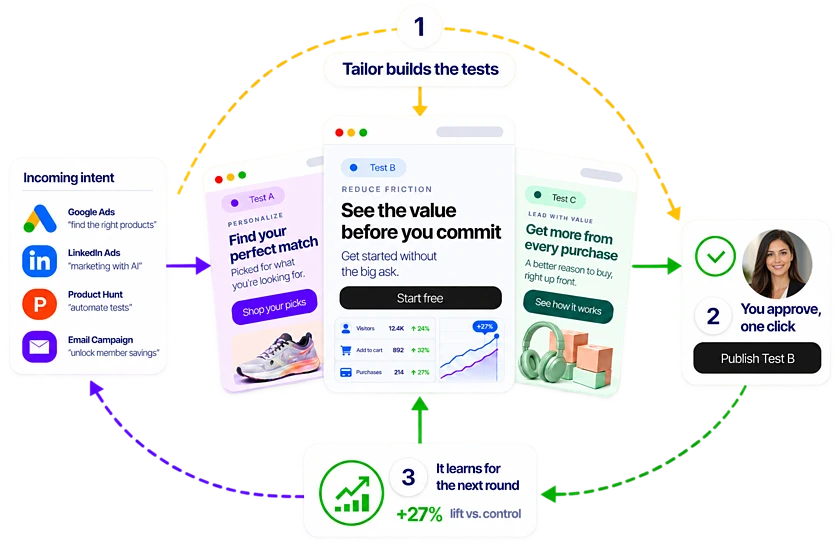
Step 1
Spot the opportunity
Monitor competitor pages and ads alongside your own campaign performance.
Step 2
Get a test recommendation
Tailor proposes a promising test, the audience it serves, and why it may work.
Step 3
Review a built variant
See the change on your existing site, edit it, and approve what launches.
Step 4
Learn from the result
Measure signups, pipeline, or revenue and use the result to guide the next test.
What the demo covers
See how a campaign becomes a website test
See how your team would turn a campaign insight into a test, from the first hypothesis to the conversion goal.
- 1
Find the mismatch
Compare the campaign promise with the page experience visitors receive.
- 2
Propose the test
Review a written hypothesis and a page change matched to that intent.
- 3
Approve and launch
See how a marketer edits, reviews, and publishes without joining a dev queue.
- 4
Measure the outcome
Connect the experiment to signups, pipeline, or revenue, not only page clicks.
Leave with a concrete test to evaluate, the audience it serves, and the conversion goal that will decide whether it worked.
Comparison
At a glance
Same goal. A different approach.
Optimizely can do more across an enterprise experimentation program. Tailor is narrower by design: it turns paid-traffic, page-performance, competitor, and prior-test signals into landing-page tests a growth team can approve and launch.
Best fit team
- Optimizely
- Enterprise experimentation programs with dedicated platform owners
- Tailor AI
- SMB and mid-market growth / demand gen / performance teams
Primary workflow
- Optimizely
- Program-led experimentation across teams, often with engineering and analyst support
- Tailor AI
- Marketer-led landing page personalization and experimentation, minimal dev dependency
Creating a variant
- Optimizely
- Visual editing for web tests and server-side tools for developer-led experiments
- Tailor AI
- Agents propose and build changes for review in your existing page
Personalization targeting
- Optimizely
- Rules and audience targeting available, depth depends on implementation and data setup
- Tailor AI
- Campaign, keyword, UTM, referrer, device, location, audience segment
Enrichment-based targeting
- Optimizely
- Possible via integrations / CDP / data infrastructure, depends on stack and setup
- Tailor AI
- Company, industry, role, and related firmographic signals (when enabled)
Experimentation depth
- Optimizely
- Broader experimentation programs, deeper controls, and wider experimentation scope
- Tailor AI
- Fast landing page experiments and iterative optimization workflows
Day-to-day editing
- Optimizely
- No-code visual editing, with engineering tools for more complex changes
- Tailor AI
- Edit and review page changes in the browser
AI workflow
- Optimizely
- AI-assisted ideation, recommendations, and CRO management within Optimizely's experimentation platform; availability varies by product and plan
- Tailor AI
- Agents research campaign intent, propose tests with hypotheses, and build variants for approval
Included services
- Optimizely
- Enterprise support tiers; hands-on implementation typically through paid services or partner agencies
- Tailor AI
- Dedicated customer success plus a forward-deployed engineer who helps build your first experiments
Page performance / SEO impact
- Optimizely
- Depends on implementation pattern and page architecture
- Tailor AI
- Designed for marketing pages with performance and SEO in mind (implementation still matters)
Measurement and reporting
- Optimizely
- Strong experimentation measurement capabilities, downstream reporting depends on analytics stack and implementation
- Tailor AI
- Built for performance teams: monitor experiments by campaign / traffic source and connect to downstream outcomes (e.g., analytics / pipeline metrics)
Governance and approvals
- Optimizely
- Stronger enterprise governance patterns, approvals, and formal experimentation operations
- Tailor AI
- Lighter-weight workflow, fits marketer-led teams and faster iteration cycles
Setup and maintenance
- Optimizely
- Depends on deployment model, site architecture, and experimentation program maturity
- Tailor AI
- GTM tag + Chrome extension + lightweight onboarding workflow (typical landing page use cases)
Pricing model (typical)
- Optimizely
- Enterprise pricing, usually custom quotes and broader platform scope
- Tailor AI
- SMB to mid-market pricing, generally simpler packaging for performance teams
Product capabilities, packaging, and pricing can change over time. Use this page as a buyer's guide, then confirm current details with each vendor based on your plan and implementation.
In detail
How the two compare in practice
When to consider Optimizely
- You are equipping an experimentation program across marketing, product, and engineering.
- Your evaluation includes feature experimentation and organization-wide governance.
- You want to build on an existing Optimizely implementation and operating process.
When Tailor fits your team
Choose Tailor for the path from campaign evidence to an approved website test. Evaluate Optimizely when the requirement is a broader experimentation program across teams and products.
- Finding, building, and analyzing campaign tests compete for the same small team's time.
- You want campaign and keyword evidence turned into page variations ready for your review.
- You need to judge approved tests against connected signup, pipeline, or revenue goals.
The decision to make
Ask which platform helps your team ship better decisions faster, given your current traffic, resources, and approval process.
- Choose Optimizely if you run a centralized experimentation program with dedicated engineers, analysts, and stricter governance requirements.
- Main tradeoff: Tailor is optimized for marketer speed and landing page workflows. Optimizely is optimized for broader enterprise experimentation depth.
- Both products now offer AI-assisted ideation and variant creation. The durable difference is focus: Tailor is organized around the campaign-to-page workflow and the conversion outcomes a performance team owns; Optimizely spans a wider enterprise experimentation program.
Switching from Optimizely
Expect the day-to-day workflow to change more than the feature set. What usually stays the same: Your existing landing pages and site structure; Your analytics stack (e.g., GA4 / Amplitude); Your campaign traffic and targeting strategy.
What usually changes: Faster marketer-led variant creation and editing; Simpler workflows for campaign and landing page experimentation; Less dependency on engineering for day-to-day test launches.
Worth validating during evaluation: Which pages and experiences you need to support first; How targeting rules map from your current setup; What reporting your team actually uses to make decisions; Approval and governance requirements for production changes.
Run a side-by-side evaluation on one real landing page workflow, not a generic demo. Compare time-to-launch, iteration speed, and reporting quality for your team.
What to compare on one real page
- Time to launch first variant
- Who owns changes day-to-day (marketer vs engineering)
- Targeting flexibility for campaign / keyword / audience use cases
- QA and approval workflow
- Reporting quality for decisions your team actually makes
- Total setup and maintenance overhead
Questions to validate before you choose Optimizely
Recurring review themes point to useful questions. They do not describe every customer's experience, so test them against your own workflow.
Learning curve and the need for experienced resources
Evaluate it by asking: Have the actual day-to-day owner build, target, QA, and read one paid-landing-page test in both products. Source: G2 review themes
Cost can be difficult to justify for a narrower use case
Evaluate it by asking: Price the products against the specific pages, traffic, users, support, and governance your team will use, rather than comparing headline platform breadth. Source: G2 reviews
Questions worth asking both vendors
- Which teams can ship changes day-to-day: marketers, engineers, or both?
- What does "personalization" include in your product: targeting, copy generation, layout changes, or all of the above?
- How do you prevent performance regressions, QA issues, and broken analytics when launching variants?
- What level of traffic is needed for useful results in our use case?
- What approvals or governance steps are required before launching a test?
- Which integrations are required for downstream measurement (e.g., GA4, Amplitude, CRM)?
- How long does it take to launch our first real experiment on an existing page?
- What does migration or onboarding support look like for our team?
FAQ
Frequently asked questions
Most teams searching for an Optimizely alternative want experimentation without the enterprise implementation weight. Tailor gives growth teams per-segment landing page testing with marketer-led speed: no dev queue, built-in company enrichment, AI agents that propose and build the tests you approve, and results tied to signups and revenue. And you are not left alone with the software: dedicated customer success and a forward-deployed engineer help your team ship its first experiments. If your experimentation program is enterprise-wide and engineering-led, Optimizely remains the stronger fit.
It depends on your use case. For performance marketing teams focused on landing page personalization and experimentation, Tailor can often serve as the better-fit workflow. For broader enterprise experimentation programs with heavier governance and cross-team requirements, Optimizely may be a better fit.
Yes. Tailor is designed to help teams personalize and test existing marketing pages without requiring a full page rebuild in most common workflows.
Tailor supports targeting using campaign and intent signals such as UTMs, keyword, referrer/source, device, location, and audience segments. Enrichment-based targeting (e.g., company / industry / role) may also be available depending on setup.
It depends on your baseline conversion rate, expected lift, and how fast your pages receive traffic. During evaluation, compare not just statistical significance, but also iteration speed and decision quality.
Tailor is built for marketing page workflows where performance and SEO matter. As with any implementation, impact depends on site architecture, setup, and how changes are deployed.
Tailor can fit into common analytics workflows used by growth teams. Confirm your specific reporting and event requirements during evaluation.
Tailor is best for growth, demand gen, and performance marketing teams that need a fast, marketer-led workflow for personalization and testing.
Optimizely offers no-code visual editing as well as developer tools. The work involved depends on the experiment, integrations, and your review process. Evaluate both products on the same campaign and page: who builds the variant, who approves it, and how your team reads the result.
Tailor focuses its agents on the paid-traffic workflow: research visitor intent, propose a test with a written hypothesis, build the variant, and learn from results, with you approving what ships. Optimizely also offers AI-assisted ideation, recommendations, and CRO management. Evaluate both on one real campaign and page, because availability and depth vary by Optimizely product and plan.
Dedicated customer success plus a forward-deployed engineer who helps set up targeting, build your first experiments, and wire up measurement. This is included with the product rather than sold as a services tier, because tests that actually ship are the point.
Other comparisons
- Tailor vs Fermat
- Tailor vs Flint
- Tailor vs Ploy
- Tailor vs SplitSense
- Tailor vs Userled
- Tailor vs Abmatic AI
- Tailor vs Tofu
- Tailor vs HubSpot Smart Content
- Tailor vs Salesforce Personalization
- Tailor vs Conversion.ai
- Tailor vs Freshmarketer
- Tailor vs VWO
- Tailor vs Mutiny
- Tailor vs AI page builders
- Tailor vs Coframe
- Tailor vs Webflow Optimize
- Tailor vs Visitor identification tools
- Tailor vs Unbounce
- Tailor vs Instapage
- Tailor vs AB Tasty
- Tailor vs Adobe Target
- Tailor vs Kameleoon
- Tailor vs Convert
- Tailor vs Dynamic Yield
Your page. Your campaign. A concrete next step.
See what Tailor would test on your site.
We’ll look at where your page could better match visitor intent, show how a variation gets built, and discuss the goal you would measure. Compare that workflow with Optimizely on work your team actually needs to do. Have a campaign in mind? Bring it. No preparation required.
Explore the fit on a demo, or start with a site scan.