
Guide · Tools
Best AI Landing Page Personalization Tools for Performance Marketing (2026)
Most paid landing pages fail for a boring reason: they’re generic. Not because marketers are lazy. Because shipping variants is expensive. “Let’s test a better headline” becomes a 2-week project, so teams stop iterating. CAC creeps up. ROAS drifts.
AI personalization tools exist to fix that: velocity. The best teams do four things well:
- Know who's on the page (audience + context, sometimes enrichment)
- Ship tailored variants fast (without a two-week dev cycle)
- Measure what matters (trial starts, revenue, pipeline)
- Spot what's breaking (so CAC doesn't quietly creep for two weeks)
This guide is about operating model fit, not who has the longest feature list. If you’re evaluating alternatives, it covers the tradeoffs.
By Greg Bayer · Last updated September 12, 2026
 Tailor AI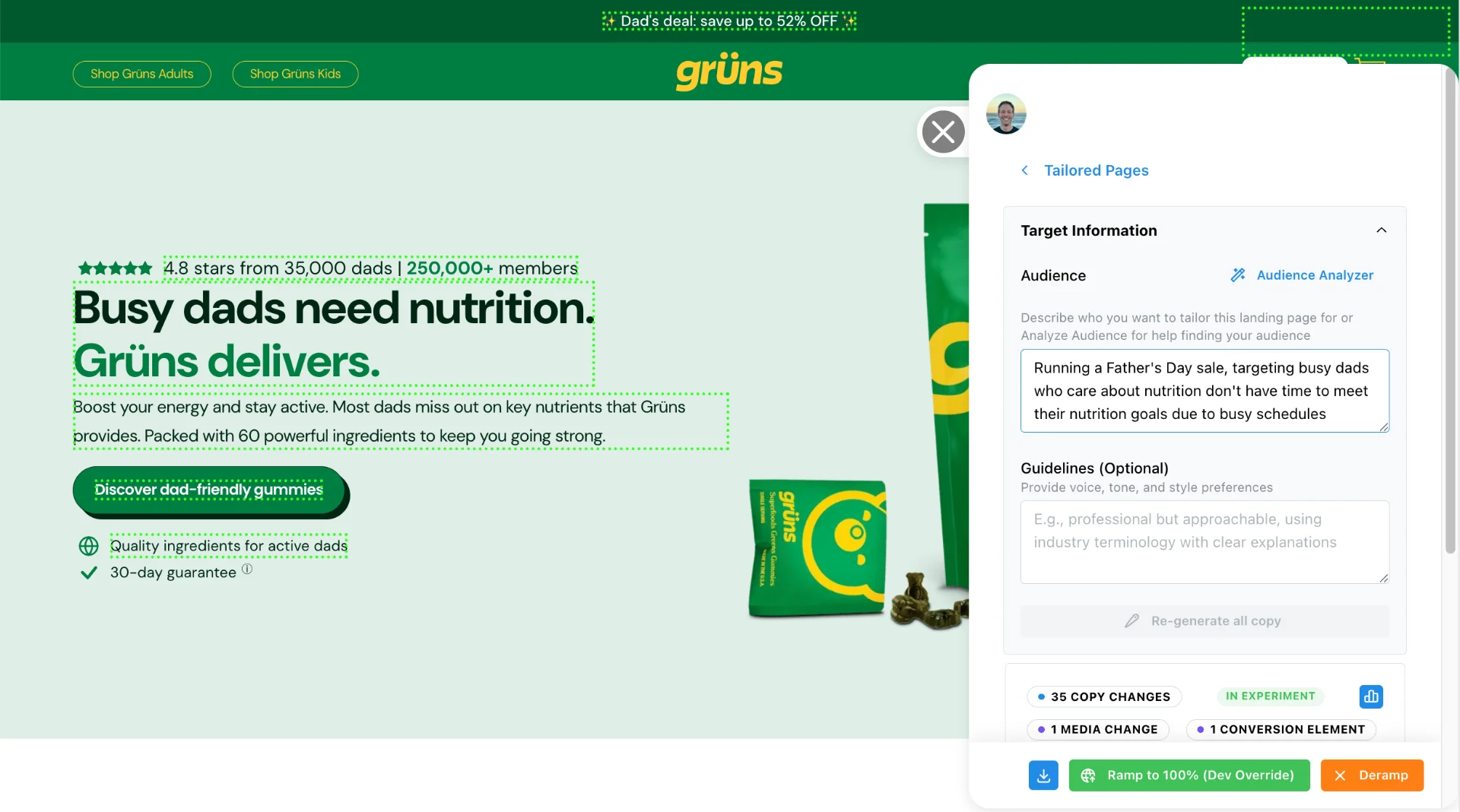
- Who this is for
- Performance teams where paid spend matters, the website is a bottleneck, and you want more experiments than your dev queue allows.
- Methodology
- Primary vendor pages only for claims. If something isn't explicit on their product page, it's treated as "verify," not "true."
Teams running Tailor






TL;DR
The short answer
- If you need marketer-led velocity on existing pages → Tailor AI
- If you want always-on automated optimization and have the volume → Coframe
- If you're Webflow-native → Webflow Optimize
- If you have an experimentation org → Optimizely Web Experimentation
- If you want a full CRO suite → VWO
- If you only need measurement and attribution → HockeyStack
GTM asset generation (Mutiny) and attribution (HockeyStack) are adjacent tools, covered in the shortlist below.
Decision framework
Pick the right tool in 60 seconds
Ask “why are we losing?” and don’t lie to yourself.
- We're losing because we can't ship tests.
- You need a workflow where marketers can publish variants without begging engineering.
- We're losing because we ship, then stop.
- You need a system that keeps optimization moving without constant human ideation.
- We're losing because the website platform is the constraint.
- If you're in Webflow, the native path is often the least painful.
- We're losing because we need rigor.
- If you're doing multivariate, bandits, governance, and program-level standardization, you're shopping enterprise experimentation.
- We're not losing on the page, we're blind.
- Then you need attribution and outcome measurement. That's the scoreboard, not the engine.
Tools don’t fail on features. They fail because they don’t match your operating model.
Context
What these tools actually do (three layers people mix up)
- Personalization
- Show different messaging to different visitors based on context.
- Experimentation
- Prove it caused lift, not just that it "felt better."
- Outcome linkage
- Connect variants to the metric that matters (CAC/ROAS, revenue, pipeline), not just clicks.

One tool rarely nails all three. Expect tradeoffs.
The shortlist
Grouped by operating model
Category A: Speed-first, marketer-led iteration
Tailor AI
tailorhq.ai ↗Marketer-led iteration, speed-first
- Best for
- Performance teams where paid spend is real and the website is a bottleneck.
- Why teams pick it
- Tailor is built for teams where the bottleneck is shipping, not ideation.Fast iteration on existing pages. Targeting uses campaign context (UTMs, geo, device, referrer) and, when needed, company-level signals. Built-in experimentation to measure lift. Integrations into common analytics stacks (GA4, Amplitude, Mixpanel, Segment).The bet: ship faster, learn faster, waste less spend on generic pages.
- Watch-outs
- If you need heavy governance, deep warehousing, or a centralized experimentation program, validate fit. Some teams need program infrastructure, not iteration velocity.
- Pricing
- Published. Plans from $250/mo
Category B: Always-on optimization
Coframe
www.coframe.com ↗Automated continuous optimization
- Best for
- Teams that want an always-on optimization engine, not a sprint-based testing workflow.
- What it is
- Coframe is built around a continuous loop: generate variations, learn from performance, and keep iterating over time. The goal is compounding improvements without requiring your team to constantly queue up test ideas.
- Why teams pick it
- Because most teams don't have the bandwidth to run a disciplined experimentation cadence week after week. Coframe is designed to keep optimization moving even when the team is busy.
- Watch-outs
- Traffic requirement: works best on high-volume pages. Low volume means slow learning or noisy results. Also clarify the engagement model: how much is self-serve vs managed.
- Pricing
- Not published. Contact sales
Category C: Platform-first, CMS-native experimentation
Webflow Optimize
webflow.com/feature/optimize ↗Platform-native experimentation
- Best for
- Teams already on Webflow that want experimentation and personalization without adding another layer of tooling.
- Why teams pick it
- Native path usually means fewer integrations, less glue, and fewer "why is this tag firing twice" afternoons.
- Watch-outs
- If you're not Webflow-native, confirm what's truly supported outside that ecosystem before assuming it's CMS-agnostic.
- Pricing
- Published as part of Webflow's site and workspace plans
Category D: Rigor-first, enterprise experimentation programs
Optimizely Web Experimentation
www.optimizely.com/products/web-experimentation ↗Enterprise experimentation, rigor-first
- Best for
- Teams that treat experimentation as a formal program with governance, statistical rigor, and standardization.
- Why teams pick it
- Program infrastructure: A/B, multivariate, bandits, collaboration, governance.
- Watch-outs
- Packaging varies by tier. Validate what's included, what requires add-ons, and how much implementation work is involved.
- Pricing
- Not published for Web Experimentation. Enterprise quote
VWO
vwo.com ↗CRO suite
- Best for
- Teams that want one vendor across testing, behavior analytics, and related modules.
- Why teams pick it
- Suite breadth. Often a consolidation play.
- Watch-outs
- Suite breadth can become suite complexity. Confirm what modules you're actually buying and the implementation overhead.
- Pricing
- Quote by traffic tier. Figures not listed on the pricing page
Category E: Adjacent tools (useful, but not direct replacements)
Mutiny
www.mutinyhq.com ↗GTM asset generation
- Best for
- Teams where the bottleneck is producing customer-facing assets and messaging variations, not building an experimentation engine.
- Why teams pick it
- Fast output. GTM-facing workflows.
- Watch-outs
- If rigorous testing and measurement are requirements, verify how deeply that's supported versus content creation and targeting.
- Pricing
- Annual contract. Entry point published, in the tens of thousands
HockeyStack
www.hockeystack.com ↗Attribution and measurement layer
- Best for
- Teams that need clearer attribution and pipeline visibility. This is the scoreboard.
- Why teams pick it
- Because without measurement, most "optimization" is storytelling.
- Watch-outs
- Attribution tools don't automatically create lift. They make it visible. You still need an engine to act on it.
- Pricing
- Not published. Contact sales
Direct answer
What are the main alternatives to Optimizely?
The main alternatives to Optimizely Web Experimentation are VWO, AB Tasty, Adobe Target, Kameleoon, Convert.com, Dynamic Yield, Tailor AI, Coframe, Webflow Optimize, Statsig and GrowthBook. Which one fits depends on why you are leaving Optimizely.
- Tests never get shipped: Tailor AI reads your ad accounts and traffic, proposes the next test with a hypothesis, builds the variant, and launches it when a marketer approves. Plans start at $250/mo. Closest fit for paid acquisition teams with no CRO specialist.
- You want one marketer-run suite: VWO and AB Tasty both combine testing with personalization and, in VWO’s case, heatmaps and session recordings.
- You are already inside an enterprise stack: Adobe Target if Adobe Analytics and Experience Platform are running and staffed; Dynamic Yield if product recommendations and merchandising are the real requirement.
- Compliance drives the decision: Kameleoon and Convert.com both build their positioning around consent handling and data minimisation. Convert publishes its pricing, which most of this category does not.
- Engineering leads experimentation: Statsig and GrowthBook put experiments next to feature flags and product analytics; GrowthBook is open source and runs stats on your own warehouse.
- Optimization should run itself: Coframe iterates continuously on high-traffic pages; Webflow Optimize is the native option if the site already lives in Webflow.
What the switch is worth depends on which of those problems you have. Teams that moved to Tailor because pages were not getting changed have published numbers: Headspace lifted conversion rate 91% by tailoring pages to visitor intent, PropertyGuru raised click-through 69% on its guide pages, and PDF Expert raised click-through 43% by matching pages to the SEM keyword that paid for the click.
Before you shortlist, count the tests that actually went live in the last six months and name what stopped the rest. If the answer is capacity rather than capability, a platform with more features will not change the number. Full side-by-side detail is in the Optimizely alternatives guide and the Tailor vs Optimizely comparison.
Curious if Tailor fits your team?
Summary
Capability matrix
Based on primary vendor documentation. Verify before buying.
| Tool | Best for | Operating model | Tradeoff |
|---|---|---|---|
| Tailor AI | Shipping is the bottleneck | Marketer-led iteration | Speed + control. Lighter on governance and warehousing. |
| Coframe | You want optimization running continuously | Automated continuous optimization | Always-on. Needs volume to learn fast. |
| Webflow Optimize | You're on Webflow | Platform-native | Fewer integrations. Webflow-only. |
| Optimizely | You have an experimentation org | Enterprise program | Full rigor + governance. Enterprise complexity. |
| VWO | You want a CRO suite | Multi-module suite | Suite breadth. Suite complexity. |
| Mutiny | You need GTM asset output | Asset generation | Fast output volume. Lighter on experimentation depth. |
| HockeyStack | You need the scoreboard | Attribution layer | Measurement clarity. Doesn't create lift itself. |
Tailor AI
- Best for
- Shipping is the bottleneck
- Operating model
- Marketer-led iteration
- Tradeoff
- Speed + control. Lighter on governance and warehousing.
Coframe
- Best for
- You want optimization running continuously
- Operating model
- Automated continuous optimization
- Tradeoff
- Always-on. Needs volume to learn fast.
Webflow Optimize
- Best for
- You're on Webflow
- Operating model
- Platform-native
- Tradeoff
- Fewer integrations. Webflow-only.
Optimizely
- Best for
- You have an experimentation org
- Operating model
- Enterprise program
- Tradeoff
- Full rigor + governance. Enterprise complexity.
VWO
- Best for
- You want a CRO suite
- Operating model
- Multi-module suite
- Tradeoff
- Suite breadth. Suite complexity.
Mutiny
- Best for
- You need GTM asset output
- Operating model
- Asset generation
- Tradeoff
- Fast output volume. Lighter on experimentation depth.
HockeyStack
- Best for
- You need the scoreboard
- Operating model
- Attribution layer
- Tradeoff
- Measurement clarity. Doesn't create lift itself.
Positioning
Where Tailor fits (and where it doesn't)
If you’re a performance team, the common failure mode isn’t “we lack ideas.” It’s “we can’t ship enough iterations to learn.”
Tailor is built for that constraint: tighten the ad-to-page loop, ship faster, test more, waste less spend on generic pages.
On the other hand, if you’re operating a centralized experimentation program with deep governance and program reporting, enterprise platforms exist for a reason. They’re not “better.” They’re built for a different org.
The core contrast is: velocity vs program maturity.
Vendor evaluation
How to evaluate vendors (questions that expose the truth fast)
- 1
How do you target visitors: basic rules only, or deeper audience context (including enrichment)?
- 2
Do you measure beyond on-page conversions, or does it stop at clicks and submits?
- 3
Who creates the learning loop: your team, or the system continuously?
- 4
What happens with low traffic or heavy segmentation?
- 5
What engineering is required after install?
- 6
What does success look like in the first 14 days?
If a vendor can’t answer #6 clearly, it’s going to be slow.
Deep dives
Full side-by-side comparisons
Operating models, targeting, where each wins, and questions to ask on the sales call.
FAQ
Frequently asked questions
Both, eventually. Personalization without experiments is storytelling. Experiments without segmentation is averaging.
Not on your homepage. In guides like this, yes, if you're defining criteria and helping buyers choose. The goal is clarity, not dunking.
Fix ad-to-page promise mismatch first. Then tailor by audience context. Then run a small number of high-confidence tests quickly.
Sources
What this guide is based on
- Tailor AI: https://tailorhq.ai
- Optimizely Web Experimentation: https://www.optimizely.com/products/web-experimentation/
- VWO: https://vwo.com
- Mutiny: https://www.mutinyhq.com
- Coframe: https://www.coframe.com
- Webflow Optimize: https://webflow.com/feature/optimize
- HockeyStack: https://www.hockeystack.com
This guide is maintained. If something is wrong or outdated, email us.
If your bottleneck is shipping, Tailor is built for that.
Book a demo and see how fast your team can ship landing page variants.