
 Tailor AIvs
 Mutiny
Mutiny starts with accounts. Tailor starts with the paid intent behind the visit.
Mutiny is built around account-based web experiences and sales use cases. Tailor is built around the journey after a paid click, combining campaign, keyword, company, competitor, and prior-test signals to recommend experiences and learn which messages move pipeline.
Explore the fit on a demo, or start with a site scan.
Last reviewed September 26, 2026 · Mutiny website
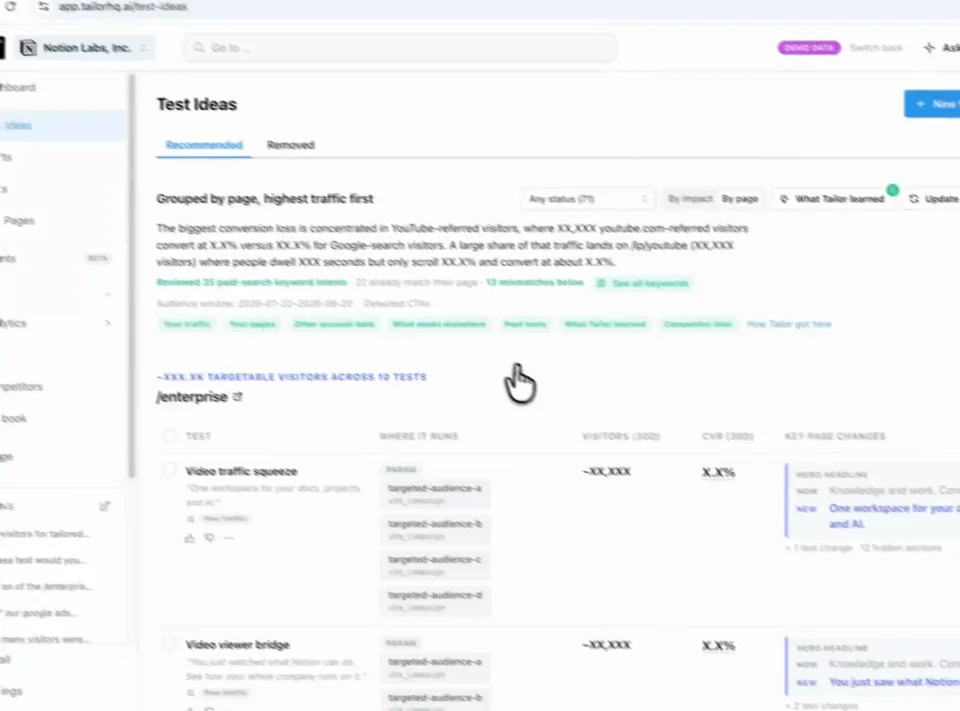
Find a test Review Approve
Teams running Tailor






Three reasons to choose Tailor over Mutiny
Personalize for the reason behind the visit.
Combine campaign and keyword intent with available company signals to shape the experience after a paid click.
Turn market changes into message tests.
Use competitor pages and ads alongside your campaign performance to recommend what to try on your own site.
Find the messages that move buyers forward.
Compare the tailored experience with the original and measure signups or pipeline through your connected goals.
In practice · PDF Expert
You paid for the click. Make the page match the intent.
Someone searching for an Adobe alternative needs a different reason to buy than someone looking to fill a PDF. PDF Expert tested keyword-specific messaging instead of sending every search to the same generic pitch.

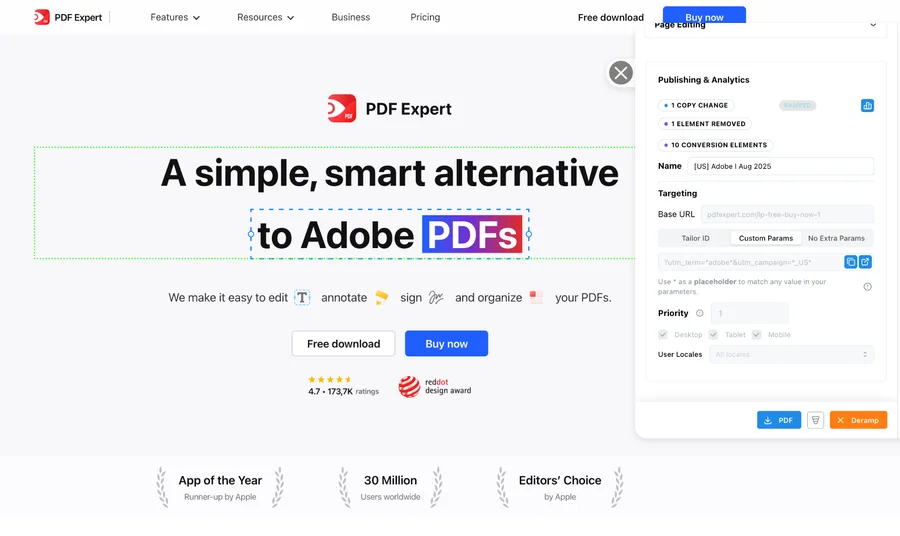
- +10%
- click-through lift for the Adobe variation shown above
- 5 minutes
- reported setup per keyword-specific page variation
- 20+
- keywords tested simultaneously in the program
The learning was specific: some keyword and region combinations improved; others did not. Testing showed where tailoring helped. These are this customer’s reported results, not a forecast for your site.
See the tests and resultsFrom signal to shipped test
Know what to test. Get it ready to launch.
Tailor monitors competitor pages and ads, combines those signals with your campaign data, and recommends tests for your site. It builds the variant for your review, measures the result, and carries the learning into what comes next.
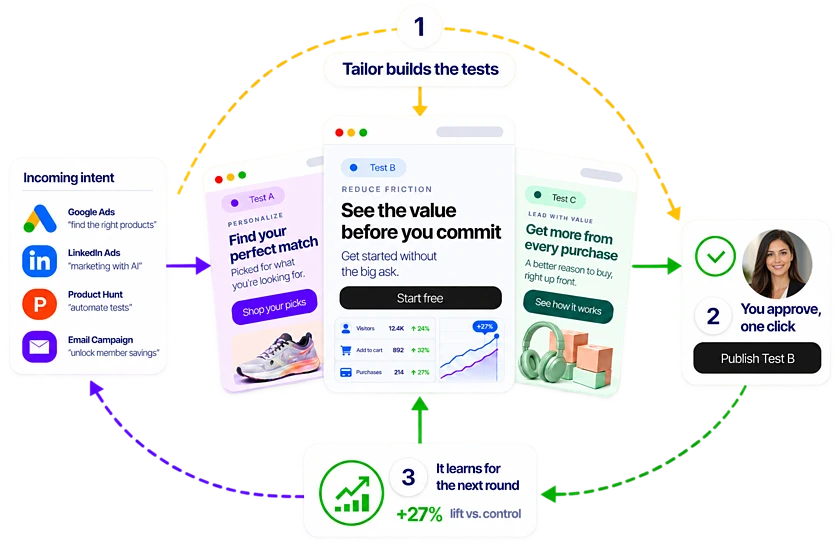
Step 1
Spot the opportunity
Monitor competitor pages and ads alongside your own campaign performance.
Step 2
Get a test recommendation
Tailor proposes a promising test, the audience it serves, and why it may work.
Step 3
Review a built variant
See the change on your existing site, edit it, and approve what launches.
Step 4
Learn from the result
Measure signups, pipeline, or revenue and use the result to guide the next test.
What the demo covers
See how a campaign becomes a website test
See how your team would turn a campaign insight into a test, from the first hypothesis to the conversion goal.
- 1
Find the mismatch
Compare the campaign promise with the page experience visitors receive.
- 2
Propose the test
Review a hypothesis and a page change matched to that intent.
- 3
Approve and launch
See how your team edits, reviews, and publishes the variant.
- 4
Measure the outcome
Evaluate the test using your connected conversion goals.
Leave with a concrete test to evaluate, the audience it serves, and the conversion goal that will decide whether it worked.
Comparison
At a glance
Same goal. A different approach.
Both products can personalize paid and inbound experiences. Mutiny's center of gravity is account-based GTM and deal acceleration. Tailor's is paid-traffic message match, experimentation, and downstream learning on the pages you already run.
Who it's for
- Mutiny
- Enterprise ABM and demand gen teams targeting named accounts
- Tailor AI
- SMB and mid-market performance marketing teams (paid, demand gen, growth)
Primary use case
- Mutiny
- Account personalization: show different website experience to known companies
- Tailor AI
- Paid traffic conversion: match landing page to ad campaign, keyword, or audience
Targeting input
- Mutiny
- IP-based firmographics, CRM/MAP data, intent signals, account lists
- Tailor AI
- UTM params, keyword, ad campaign, referrer, geo, device, audience segment
Company enrichment
- Mutiny
- Core capability. Deep firmographic and intent data integrations (6sense, Bombora, CRM)
- Tailor AI
- Built-in IP-based identification (industry, size, role). Used for personalization and visitor intelligence
Traffic type
- Mutiny
- Organic, direct, ABM outreach, target account lists
- Tailor AI
- Paid (Google, LinkedIn, Meta, etc.) and any traffic with identifiable signals
Operating model
- Mutiny
- Marketer-led with data integrations (MAP, CRM), longer setup
- Tailor AI
- Marketer-led: browser extension, no dev required, ships in minutes
Downstream metrics
- Mutiny
- Pipeline and revenue attribution through CRM integration
- Tailor AI
- Signups, pipeline, revenue. Events fire into GA4, Amplitude, and Segment
AI copy generation
- Mutiny
- AI recommendations for account-level personalizations
- Tailor AI
- Yes, in the editing workflow, with recommendations for what to test next
A/B testing
- Mutiny
- Available
- Tailor AI
- Built-in per-segment testing with downstream metrics
Page load impact
- Mutiny
- Client-side personalization, some page weight
- Tailor AI
- Async script, minimal Lighthouse impact, designed to preserve SEO
Price range
- Mutiny
- Enterprise pricing (contact Mutiny for current plans)
- Tailor AI
- SMB to mid-market SaaS pricing
Setup
- Mutiny
- JS snippet + CRM/MAP integrations, onboarding support
- Tailor AI
- GTM tag + Chrome extension, self-serve onboarding
In detail
How the two compare in practice
When to consider Mutiny
- Your GTM is account-based and you need to personalize the full website for target accounts, not just landing pages
- You have CRM/MAP data (Salesforce, HubSpot, Marketo) you want to activate on-site for named accounts
- You need deep intent data integrations (6sense, Bombora) to trigger personalizations
- Your highest-value traffic comes from organic or direct visits, not paid campaigns
- You have enterprise budget and need account-level analytics tied to pipeline
When Tailor fits your team
Compare the center of gravity. Mutiny is organized around accounts and deals. Tailor is organized around paid intent, page experiments, and the conversion outcomes behind acquisition spend.
- Your primary pain is dozens of ad variants pointing to generic landing pages, and you need to close that message gap fast
- You want to ship page variants per campaign, keyword, or audience in minutes without dev resources
- You need to measure downstream impact (signups, pipeline, revenue), not just page-level conversion
- You want built-in company enrichment without buying a separate firmographic data vendor
- You need SMB or mid-market pricing, not enterprise contracts
- You want a tool designed to minimize Lighthouse impact and preserve SEO
The decision to make
Ask where your highest-value traffic originates. If it's paid ads (Google, LinkedIn, Meta), Tailor closes the ad-to-page gap. If it's organic or direct visits from target accounts, Mutiny's ABM approach fits. Many B2B teams eventually need both.
- Tailor includes built-in company enrichment, but the primary use case is matching paid ad messaging to landing pages and measuring downstream impact (signups, pipeline, revenue). Mutiny's primary use case is showing different content to target accounts based on CRM and firmographic data.
- These tools can coexist. Some B2B teams use Tailor for paid acquisition pages and Mutiny for organic/ABM website personalization. But if budget is a constraint, choose based on where your highest-value traffic originates.
- Compare current plans and quotes for the audiences, integrations, and account workflows you actually need. Tailor publishes its plans; evaluate the full cost of the workflow rather than a historical price estimate.
FAQ
Frequently asked questions
Most teams searching for a Mutiny alternative want account-aware personalization without enterprise ABM pricing. Tailor includes IP-based company enrichment (industry, size, role) as a built-in signal, personalizes the pages you already have, and measures downstream impact per segment. It is priced for SMB and mid-market growth teams. If your motion is full ABM orchestration on named-account lists with CRM and intent-data integrations, Mutiny remains the purpose-built option.
Other comparisons
- Tailor vs Fermat
- Tailor vs Flint
- Tailor vs Ploy
- Tailor vs SplitSense
- Tailor vs Userled
- Tailor vs Abmatic AI
- Tailor vs Tofu
- Tailor vs HubSpot Smart Content
- Tailor vs Salesforce Personalization
- Tailor vs Conversion.ai
- Tailor vs Freshmarketer
- Tailor vs Optimizely
- Tailor vs VWO
- Tailor vs AI page builders
- Tailor vs Coframe
- Tailor vs Webflow Optimize
- Tailor vs Visitor identification tools
- Tailor vs Unbounce
- Tailor vs Instapage
- Tailor vs AB Tasty
- Tailor vs Adobe Target
- Tailor vs Kameleoon
- Tailor vs Convert
- Tailor vs Dynamic Yield
Your page. Your campaign. A concrete next step.
See what Tailor would test on your site.
We’ll look at where your page could better match visitor intent, show how a variation gets built, and discuss the goal you would measure. Compare that workflow with Mutiny on work your team actually needs to do. Have a campaign in mind? Bring it. No preparation required.
Explore the fit on a demo, or start with a site scan.