
Guide · Alternatives
7 Optimizely Alternatives for Teams That Want to Move Faster (2026)
Optimizely is the reference platform for enterprise experimentation, and it earned that position. Feature flags, a serious stats engine, and program management built for organizations that treat testing as a formal discipline. If that describes your company, you probably shouldn’t be reading a list of Optimizely alternatives.
But for a lot of buyers, the reference platform is exactly the problem. Implementation is a project, not an install. Engineering owns the tool, so every test idea becomes a ticket. The contract is sized for a program you don’t run yet, so you pay for headroom you never use. And the governance that makes Optimizely safe at enterprise scale becomes the thing that stops a three-person growth team from shipping anything this week.
This guide ranks 7 Optimizely alternatives by what they actually do and who they fit, including an honest section on who shouldn’t switch at all. It pairs with our Tailor vs Optimizely comparison for the head-to-head detail, and with our broader A/B testing tools guide if you’re surveying the whole category.
By Tailor AI team · Last updated July 20, 2026
 Tailor AI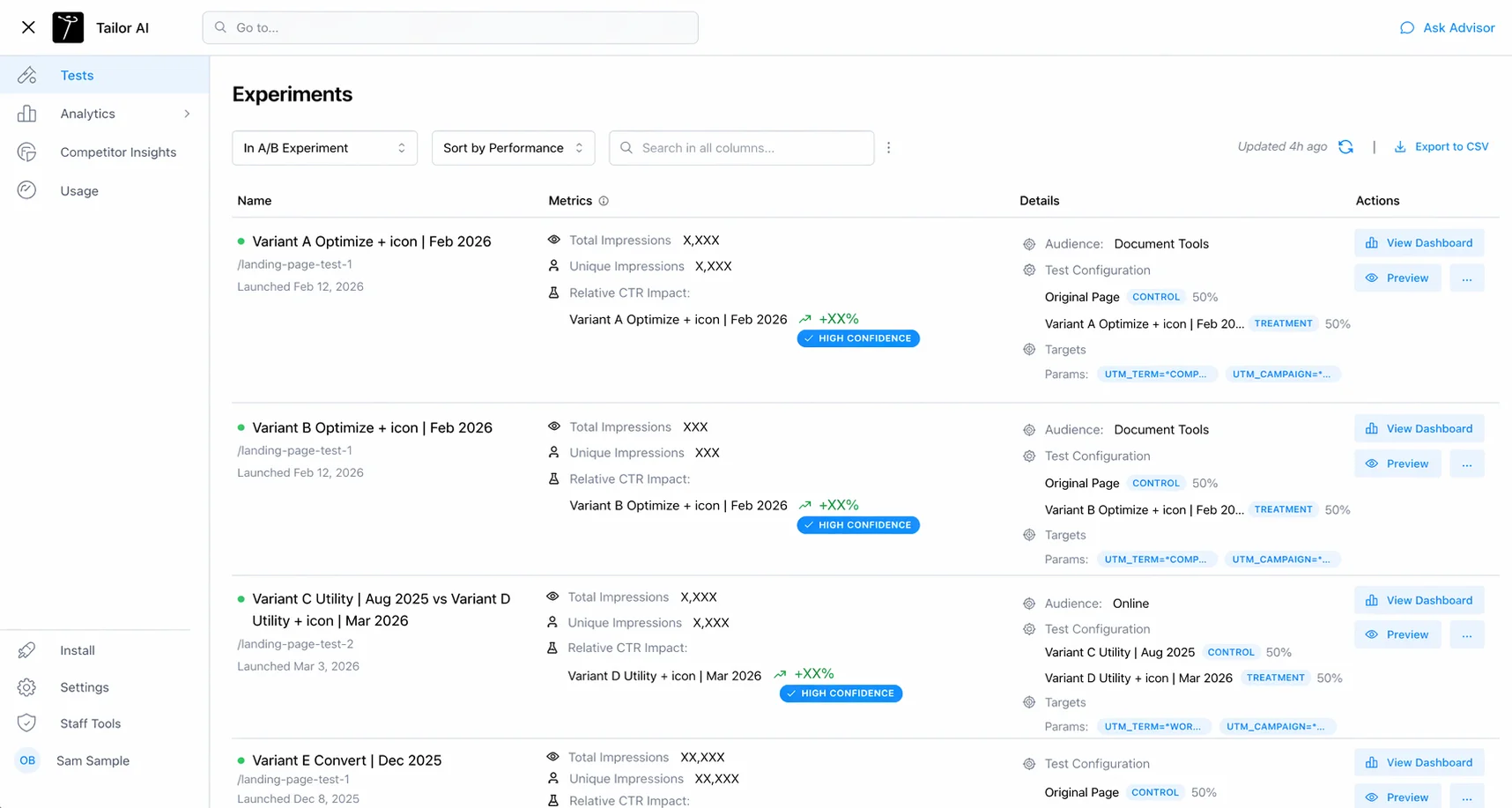
- Who this is for
- Growth, marketing, and product teams evaluating whether an enterprise experimentation platform is the right weight for how they actually work, or reviewing an upcoming renewal.
- Methodology
- Claims come from primary vendor pages and documentation. No review scores, no pricing guesses, no invented stats. If a capability isn't explicit on the vendor site, treat it as verify, not true.
Teams running Tailor






TL;DR
The short answer
- If your real problem is that tests don't get shipped, and you want them found, built, and launched for you → Tailor AI
- If you want one mid-market suite for testing plus heatmaps and recordings → VWO
- If marketing leads experimentation and wants personalization in the same tool → AB Tasty
- If you need focused testing with a privacy-first approach, or you're an agency → Convert.com
- If you're in a regulated industry or the EU and compliance shapes the shortlist → Kameleoon
- If engineering leads and wants experiments next to product analytics → PostHog
- If you want open source and stats that run on your own warehouse → GrowthBook
And if governance is genuinely the point of your program, stay on Optimizely. More on that below.
Context
Why teams look for an Optimizely alternative
Almost nobody leaves Optimizely because the product is bad. They leave because of a mismatch between what the platform assumes and how their team actually works. Optimizely assumes a program: dedicated owners, engineering support, analysts, review workflows. That’s a strength when the program exists. When it doesn’t, every one of those assumptions turns into overhead.
The complaints we hear on calls cluster into four buckets. Implementation took a quarter before the first test ran. Marketers can’t ship changes without engineering, so the dev queue caps the test cadence. The team uses a fraction of the platform but pays for all of it. And the approval process designed to protect a hundred-person org slows a five-person one to a crawl.

That last one is worth sitting with, because it’s the one teams underestimate. Here’s how an experimentation lead at a large media company put it when weighing speed against oversight:
“If we kind of concede that and we say, okay, we’ll give you the governance and the oversight you need, then I’m not sure if this actually adds any speed because that governance and communication and all that oversight becomes the bottleneck.”
That’s the honest tension. Governance and speed trade off against each other, and no tool swap changes the physics. What a tool swap can change is whether you’re paying for governance you don’t need. The list below is organized around that question: what’s actually slowing you down, and which Optimizely alternative removes that specific drag.
Honesty check
Who should not switch
Keep Optimizely when its governance and analysis workflows fit your program.
- 1
You run a formal cross-team experimentation program.
If multiple teams submit experiments through a shared process, with review boards, naming conventions, and a program owner, you're using exactly what Optimizely is built for. The overhead you might resent is the product working as intended. Switching would mean rebuilding all of that process tooling somewhere it doesn't exist.
- 2
Feature flags are the center of your engineering workflow.
If your org ships behind flags, runs server-side experiments, and ties rollouts to experiment results, you need a platform where flags and experiments share one system. Most of the tools below don't try to cover that surface, and the ones that do (PostHog, GrowthBook) are a lateral move, not an escape.
- 3
You have dedicated analysts who live in the stats engine.
Teams with statisticians who scrutinize methodology, run sequential tests, and defend results to a skeptical org get real value from Optimizely's stats rigor. If experiment credibility is a political requirement at your company, don't trade it for speed you may not be allowed to use.
If governance, consent, and data handling are what’s keeping you on an enterprise platform, our enterprise compliance guide covers how to evaluate lighter tools against those requirements before assuming only the incumbent can meet them.
The list
The 7 best Optimizely alternatives, ranked
The order reflects fit for the most common switcher we see: a team with real paid traffic, limited engineering support, and a test backlog that never ships. A different reader (a platform engineer, a data team lead) would order this differently, and the entries say so where it applies. None of these is a feature-for-feature Optimizely clone, which is the point. If you wanted the same platform, you’d stay.
1.Tailor AI
tailorhq.ai ↗Automatic experience tailoring
- What it is
- Tailor isn't an A/B testing tool, and it isn't trying to be Optimizely. It's automatic site personalization and optimization: the AI researches your traffic (campaign, keyword, audience, geo, enriched company and role), personalizes pages per segment, proposes the tests worth running, launches them when you approve, and keeps learning from the results.
- Strengths
- It attacks the problem that actually drives most Optimizely switches: tests don’t get shipped. Instead of giving your team a better engine to drive, it does the driving and leaves you the approval decision. Marketers edit live pages in the browser, so there’s no dev queue between idea and running test, and results are tied to signups, pipeline, and revenue, not just clicks. The script loads async and doesn’t change what search engines see, so it’s SEO-safe and doesn’t touch your Lighthouse score. And you don’t migrate alone: every team gets dedicated customer success and a forward-deployed engineer who helps build the first experiments, included rather than sold as a services tier.
- Limitations
- Tailor doesn’t replace Optimizely’s feature-flag or enterprise-governance surface, plainly. If engineering runs server-side experiments behind flags, or your program needs formal review workflows across many teams, this isn’t that. It’s the alternative for teams whose bottleneck is shipping, not governing. The full Tailor vs Optimizely comparison draws that line in detail.
- Best for
- Growth and performance teams at companies spending on paid acquisition, where test ideas outnumber shipped tests by ten to one.
2.VWO
vwo.com ↗CRO suite
- What it is
- VWO is a broad conversion optimization suite: A/B and multivariate testing, heatmaps, session recordings, surveys, and form analytics under one roof. It's one of the longest-running names in the category and the most common landing spot for teams stepping down from enterprise platforms.
- Strengths
- Breadth without enterprise weight. You get a real visual editor, behavior analytics for hypothesis generation, and a testing engine marketers can run day to day. For teams that liked Optimizely's capability but not its process, VWO covers most of the marketer-facing surface with a much shorter path from install to first test.
- Limitations
- The suite doesn't fix a bandwidth problem. Ideation, prioritization, building, and analysis still fall on your team, so a backlog that didn't ship on Optimizely can just as easily not ship on VWO. Confirm which modules are in your plan, and check script weight and flicker on your own pages before committing.
- Best for
- Mid-market teams with someone who owns CRO and wants testing plus behavior analytics from one vendor.
3.AB Tasty
www.abtasty.com ↗Experimentation and personalization suite
- What it is
- AB Tasty combines experimentation and personalization in one marketer-facing suite, with a library of ready-made widgets and patterns for common conversion plays. It also offers feature experimentation for product teams, and it has particular strength in the European market.
- Strengths
- The pitch is marketer-led experimentation without asking engineering's permission, which is precisely what many Optimizely refugees want. The pattern library shortens the path from idea to live test for common plays like banners and social proof, and EU teams get data-residency and support conversations that US-first vendors handle less smoothly.
- Limitations
- Rolling it out still feels enterprise: onboarding, tiers, a sales process. The personalization side depends on your team supplying the segmentation logic and the ideas. It reduces the engineering dependency, not the thinking dependency.
- Best for
- Mid-market and enterprise marketing teams, especially in Europe, that want testing and personalization from one vendor with marketing in the driver's seat.
4.Convert.com
www.convert.com ↗Privacy-focused A/B testing
- What it is
- Convert.com is a focused A/B testing tool that leads with privacy. It positions itself for teams and agencies that need GDPR-conscious testing, with attention to flicker control and account structures that agencies running many client programs tend to like.
- Strengths
- Focus is the feature. It does testing carefully and doesn't sell you six adjacent modules, which makes it a clean landing spot for teams that used ten percent of Optimizely and want to pay for that ten percent. The privacy posture is a genuine differentiator for European traffic, and agencies get multi-client management that enterprise platforms make painful.
- Limitations
- You bring the program. Convert runs the tests you design; research, ideation, variant building, and analysis stay with your team. Personalization is lighter than in dedicated engines, so per-segment experiences aren't the core play.
- Best for
- Agencies and privacy-sensitive teams that have their own testing process and want a dependable, lighter engine under it.
5.Kameleoon
www.kameleoon.com ↗Experimentation and personalization platform
- What it is
- Kameleoon offers web experimentation, feature experimentation, and personalization in one platform. It's a European vendor with visible attention to consent management and compliance, and its public positioning emphasizes regulated industries such as healthcare and financial services.
- Strengths
- For teams whose Optimizely evaluation was dominated by legal and compliance review, Kameleoon speaks that language natively: consent handling, data processing, and industry-specific requirements show up in its public documentation rather than being an afterthought. It covers both marketer-led web testing and dev-led feature experimentation, so it can serve mixed teams.
- Limitations
- It's closer to a peer of Optimizely than an escape from it: a full platform with a sales process and real implementation work, so teams fleeing enterprise weight may find a familiar shape. Outside the EU its presence is thinner, so check support coverage for your region. As with any vendor, verify specific compliance claims against your own requirements rather than taking category positioning on faith.
- Best for
- Teams in regulated industries or the EU where compliance requirements shape the shortlist before features do.
6.PostHog
posthog.com ↗Product analytics with experiments
- What it is
- PostHog is a developer-focused product analytics platform that includes feature flags and A/B experiments alongside session replay, surveys, and a data warehouse. It's open-source-rooted, self-serve, and priced by usage rather than by sales call.
- Strengths
- For engineering-led teams, the draw is having experiments live next to the product analytics that judge them: one system for flags, exposure, and downstream behavior. Self-serve signup and transparent usage-based pricing are the cultural opposite of an enterprise procurement cycle, which is exactly what some Optimizely leavers are looking for.
- Limitations
- It's built for developers, deliberately. Marketers won't get a visual editor workflow comparable to the marketer-facing suites, so website testing run by a growth team without engineering support is a poor fit. Experimentation depth is one feature among many, not the platform's center of gravity.
- Best for
- Product and engineering teams that want experiments inside the product, next to their analytics, without an enterprise sales process.
7.GrowthBook
www.growthbook.io ↗Open-source, warehouse-native experimentation
- What it is
- GrowthBook is an open-source experimentation platform built around feature flags and a stats engine that runs on your own data warehouse. Your metrics stay in your warehouse; GrowthBook queries them to analyze experiments, and you can self-host the whole thing or use their cloud.
- Strengths
- Maximum ownership. No vendor holds your experiment data, the stats methodology is open to inspection, and data teams can define metrics once in the warehouse and reuse them across every experiment. For teams that resented paying enterprise prices for a stats engine they couldn't audit, this is the philosophical opposite.
- Limitations
- Warehouse-native means you need a warehouse, defined metrics, and someone who maintains the pipeline. It's an engineering and data team's tool; there's no marketer-facing workflow for shipping website variants. Total cost of ownership is engineering time instead of license fees, which isn't automatically cheaper.
- Best for
- Data-mature teams with engineering support that want to own the experimentation stack end to end.
Leaving because tests don't get shipped?
That’s the problem Tailor exists for. Or read the full Tailor vs Optimizely comparison first.
Summary
Optimizely alternatives compared
All seven alternatives in one view, with Optimizely as the baseline they’re measured against. The operating model column is the real differentiator: who does the work, and what has to exist at your company for the tool to pay off. Based on primary vendor documentation; verify against your own requirements before buying.
| Tool | Category | Operating model | Best for |
|---|---|---|---|
| Optimizely (baseline) | Enterprise experimentation | Engineering-led program with feature flags, stats engine, and governance | Enterprise orgs running testing as a formal cross-team discipline |
| Tailor AI | Automatic experience tailoring | AI researches traffic, personalizes per segment, proposes tests, launches on approval | Growth teams whose real problem is tests not getting shipped |
| VWO | CRO suite | Marketer-run testing plus heatmaps, recordings, and surveys | Mid-market teams consolidating CRO tooling under one vendor |
| AB Tasty | Experimentation + personalization | Marketer-led suite with a pattern library, strong EU presence | Marketing teams that want testing and personalization in one tool |
| Convert.com | Focused A/B testing | Testing engine with a privacy-first approach, agency-friendly accounts | Agencies and privacy-sensitive teams with their own process |
| Kameleoon | Experimentation + personalization | Web and feature experimentation with attention to consent and compliance | Regulated industries and EU teams with strict data requirements |
| PostHog | Product analytics + experiments | Dev-led platform where experiments sit next to product analytics and flags | Engineering teams testing inside the product, not just the site |
| GrowthBook | Open-source experimentation | Warehouse-native stats on your own data, self-hosted or cloud | Data-mature teams that want to own the stack |
Optimizely (baseline)
- Category
- Enterprise experimentation
- Operating model
- Engineering-led program with feature flags, stats engine, and governance
- Best for
- Enterprise orgs running testing as a formal cross-team discipline
Tailor AI
- Category
- Automatic experience tailoring
- Operating model
- AI researches traffic, personalizes per segment, proposes tests, launches on approval
- Best for
- Growth teams whose real problem is tests not getting shipped
VWO
- Category
- CRO suite
- Operating model
- Marketer-run testing plus heatmaps, recordings, and surveys
- Best for
- Mid-market teams consolidating CRO tooling under one vendor
AB Tasty
- Category
- Experimentation + personalization
- Operating model
- Marketer-led suite with a pattern library, strong EU presence
- Best for
- Marketing teams that want testing and personalization in one tool
Convert.com
- Category
- Focused A/B testing
- Operating model
- Testing engine with a privacy-first approach, agency-friendly accounts
- Best for
- Agencies and privacy-sensitive teams with their own process
Kameleoon
- Category
- Experimentation + personalization
- Operating model
- Web and feature experimentation with attention to consent and compliance
- Best for
- Regulated industries and EU teams with strict data requirements
PostHog
- Category
- Product analytics + experiments
- Operating model
- Dev-led platform where experiments sit next to product analytics and flags
- Best for
- Engineering teams testing inside the product, not just the site
GrowthBook
- Category
- Open-source experimentation
- Operating model
- Warehouse-native stats on your own data, self-hosted or cloud
- Best for
- Data-mature teams that want to own the stack
Decision framework
Choose a tool based on your bottleneck
Comparing any of these tools to Optimizely feature by feature guarantees a bad decision, because Optimizely wins most feature checklists. The right question is which bottleneck made you search for an Optimizely alternative in the first place.
- Tests get proposed but never shipped.
- Your bottleneck isn't the testing engine, it's everything around it: noticing what to test, building the variant, getting it live. Tailor is built for exactly this: the AI proposes tests from your traffic, builds them, and launches on your approval. Read the Tailor vs Optimizely comparison before assuming you need another engine.
- Marketing wants to own testing day to day.
- You want a marketer-run suite. VWO if you also want heatmaps and recordings for hypothesis generation, AB Tasty if personalization in the same tool matters and EU support is a plus.
- Privacy and compliance dominate every tool decision.
- Convert.com if you want a focused testing engine with a privacy-first posture. Kameleoon if you need a fuller platform and operate in a regulated industry. Either way, run your own compliance review; category positioning isn't a DPA.
- Engineering runs experiments and wants less platform, not more.
- PostHog puts experiments next to product analytics with self-serve pricing. GrowthBook goes further: open source, warehouse-native stats, and full ownership of the stack. Both trade marketer accessibility for engineering control.
- Honestly, the governance is the point.
- Then stay. Formal programs, feature-flag-centered orgs, and teams with dedicated analysts are Optimizely's home turf, and switching would cost more than the license. That was the who-should-not-switch section, and it was sincere.
One more constraint check before you commit: per-segment testing splits your sample, and low-traffic segments stall. Our traffic thresholds guide covers how much volume a real program needs. And if you’re earlier in the process than tool selection, start with the conversion rate optimization guide or the wider best CRO tools roundup.
FAQ
Frequently asked questions
There isn't one best Optimizely alternative, because teams leave for different reasons. If your real problem is that tests don't get shipped, Tailor AI attacks that directly: it researches your traffic, proposes tests per segment, builds them, and launches on your approval. If you want a marketer-run suite, look at VWO or AB Tasty. If privacy constraints drive the decision, Convert.com or Kameleoon. If engineering leads and wants experiments next to product analytics, PostHog. If you want open source and warehouse-native stats, GrowthBook. Match the tool to the bottleneck that made you search, not to Optimizely's feature list.
It depends on the job. For performance marketing teams focused on landing page personalization and per-segment testing, Tailor is often the better-fit workflow: no dev queue, tests proposed and built for you, results tied to signups and revenue. But Tailor does not replace Optimizely's feature flags or enterprise governance surface. If your experimentation program is engineering-led and cross-team with formal oversight, Optimizely may remain the better fit.
Run one real workflow side by side. Pick a live page and a real hypothesis, then measure how long each tool takes from idea to running test, who had to be involved, and what reporting looks like against your actual conversion goals. A generic demo tells you about the vendor's sales team. One real workflow tells you about your next year.
Your analytics history stays wherever it already lives, in GA4, Amplitude, or your warehouse, and that doesn't change when you switch testing tools. In-platform test history is a different story: it generally doesn't migrate anywhere, on any vendor. Before switching, export the test archive and the conclusions you care about, let in-flight experiments conclude before the cutover, and plan reporting continuity so this quarter's numbers stay comparable to last quarter's.
The pattern is consistent. Implementation took months, engineering owns day-to-day changes, the team uses a fraction of what it pays for, and governance designed for a large program slows down a small one. Renewal is when the math gets audited: teams count the tests they actually shipped last year, divide the contract by that number, and start searching for an Optimizely alternative.
For the full head-to-head on workflows, targeting, and measurement, see Tailor vs Optimizely.
Sources
What this guide is based on
- Optimizely: https://www.optimizely.com
- Tailor AI: https://tailorhq.ai
- VWO: https://vwo.com
- AB Tasty: https://www.abtasty.com
- Convert.com: https://www.convert.com
- Kameleoon: https://www.kameleoon.com
- PostHog: https://posthog.com
- GrowthBook: https://www.growthbook.io
This guide is maintained. If something is wrong or outdated, email us.
Evaluate whether the alternative helps your team build and launch tests.
Tailor researches your traffic, proposes the tests, builds them, and launches on your approval. Book a demo and watch it work on your own site.