 Tailor AI
INTEGRATION · MCP
Your agents can plan tests. Tailor MCP lets them ship tests.
Last updated July 28, 2026
Growth teams are building agents that read the warehouse, spot underperforming pages, and propose experiments. Then the plan hits the website and stops, because changing the site means a ticket and a dev queue. The Tailor MCP server closes that gap: it gives any MCP-capable agent the tools to build variants, set targeting, generate previews, and read results on your live site. You approve what ships.
The problem
Agent stacks can decide what to test but have no safe way to execute on the website. Execution falls back to humans and dev queues.
What this covers
What the Tailor MCP exposes, a real agent workflow one customer runs today, approval gating, and how it fits an existing analytics stack.

How it works
One MCP server, the full experiment loop
MCP (Model Context Protocol) is the open standard that lets AI agents call tools in other products. Tailor's MCP server exposes the same tools that power Tailor's own in-app agent, so anything Tailor can do, your agents can do through a tool call:
- Create experiments and variants: headlines, subheads, CTAs, images, and full sections
- Set targeting: campaign, keyword, UTM (including wildcard and OR matching), source, device, geo
- Modify layout and inject scripts for changes beyond copy, like popups or carousel reordering
- Generate preview links so a human can review before anything goes live
- Read results: traffic, conversion by variant, and downstream metrics
- Launch, pause, and ramp experiments, with launch permission under your control
It works with Claude, Claude Code, and the internal agent platforms teams are building on their own tooling. Setup takes a few minutes: MCP setup docs.
In production
A real agent workflow, running today
The growth team at a large productivity software company wired their internal agents to Tailor through MCP. Here is the loop one of their growth engineers runs each morning.
- 1
The agent finds the opportunity
It queries their data warehouse for high-traffic pages with weak conversion, checks the list of active experiments, and proposes three new tests with a headline, subhead, and CTA for each, plus a written hypothesis.
- 2
The human adds context the data misses
Some pages convert poorly for a known reason, like colder traffic from video channels. The engineer tells the agent why, once, and the agent remembers it for future proposals.
- 3
Each test becomes a tracked task
The agent writes a brief for every experiment in their project management tool. That task becomes the working record: the brief, the approval, and the status all live there.
- 4
The agent builds it in Tailor
On approval, the agent sets up the experiment through the Tailor MCP and posts a preview link back to the task. The engineer reviews the preview and tweaks anything that reads wrong.
- 5
A human presses launch
Their agents are allowed to set everything up but not to ship. A person gives the green light and launches. That gate is their policy, not a Tailor limitation, and it is adjustable per team.
The same team also connected their CMS's MCP server alongside Tailor's, so the agent can reference real components when proposing net-new page sections. Copy tests are the reliable core of the loop today; layout and creative work still benefits from a human pass.
Architecture
Tailor doesn't have to be your only dashboard
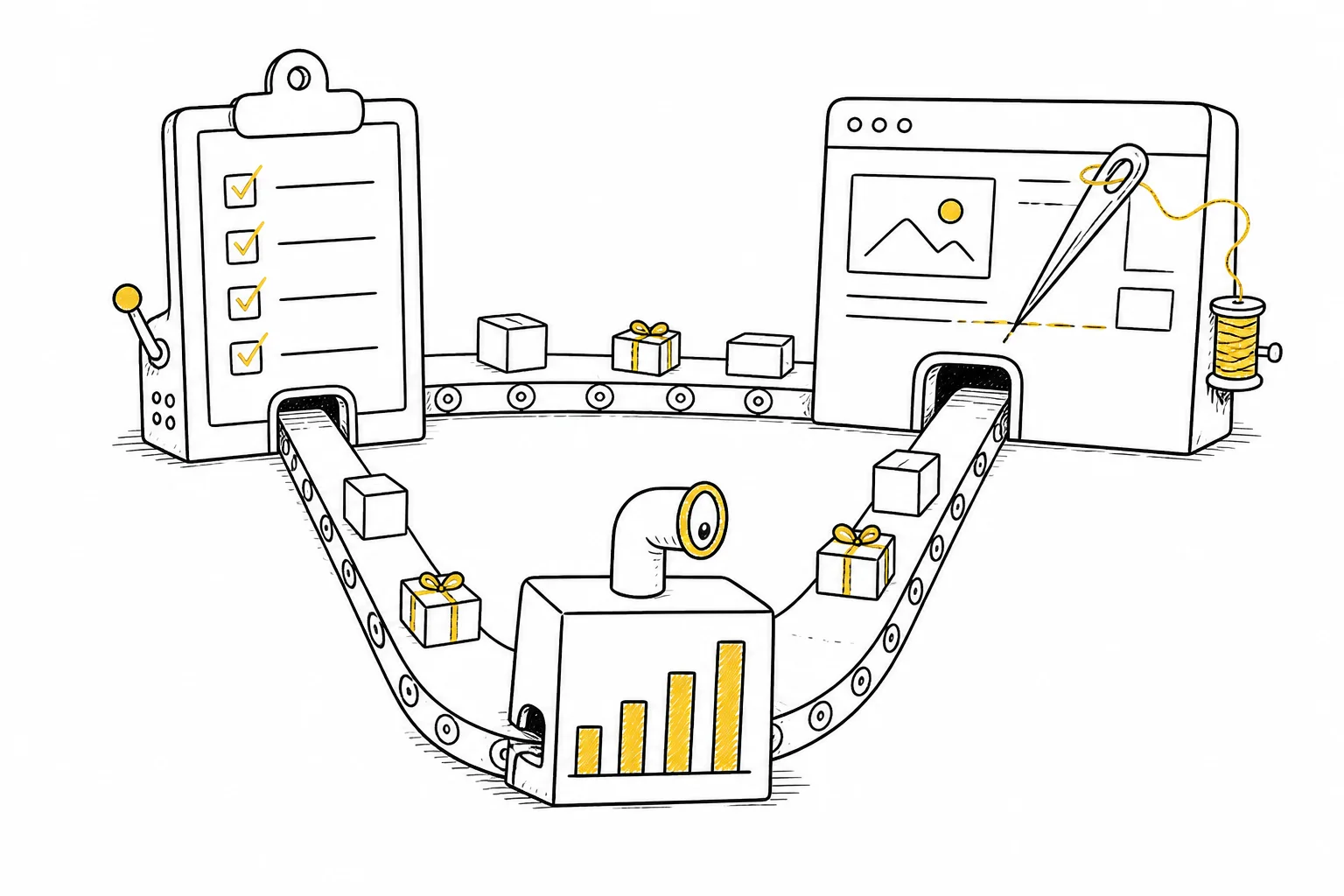
A common worry with any experimentation tool: does it demand to be the center of the universe? With MCP, it does not have to be. The productivity company above runs a clean three-way split:
Orchestration hub
Their workspace
Agents, briefs, approvals, and experiment status live in the tool the team already works in.
Execution layer
Tailor
Where experiments are built, targeted, previewed, launched, and decided on.
Reporting layer
Their warehouse
Tailor fires an event per experiment exposure. They join it with server-side conversions for reporting.
"Our workspace is the hub and source of truth. Tailor is where things are executed and decided on. The warehouse is where we pull insights from." (growth engineer, productivity software company)
If you would rather have Tailor be the orchestration layer too, it can be: Tailor's own agents research intent, propose tests, and surface next steps inside the app. The MCP exists for teams that want to own orchestration themselves.
Wire up your first agent
Read the MCP setup docs or get a demo of the full loop.
Capabilities
What teams actually do with it
Patterns from customers running agents against the Tailor MCP in production.
Morning experiment proposals
An agent reviews active experiments and page performance, then proposes new tests with hypotheses. The human's job shifts from writing tests to reviewing them.
Batch page variants at scale
A file-conversion software company bids on hundreds of long-tail search terms. From one spreadsheet, the MCP built 22 targeted page variants, each matched to multiple UTMs with OR targeting, named with a shared prefix so results group together.
Keyword-personalized pages
Pre-build a variant for every UTM term you bid on, starting with the highest-volume terms. Agents keep the set fresh and Tailor reports keep, kill, and iterate signals per variant.
Script injection for non-copy changes
Popups, carousel reordering, and changes to third-party widgets are all reachable by letting the agent inject a script, with a preview to check before launch.
Agent-updated experiment status
Because the agent executes the work, it can also keep the tracking system current: brief written, built in Tailor, launched, results in.
Guardrails
Autonomy with an approval gate
Tailor's position on agent autonomy is simple: agents run everything between the ad click and the conversion learning, and you approve what ships. The MCP follows the same rule. Every change an agent stages gets a preview link. Launch can be open to agents or reserved for humans. Nothing edits your site silently.
Teams typically start with human-gated launches, watch a few cycles, and then let agents ship low-risk copy tests on their own while keeping layout and pricing changes gated. The gate is policy you set, not a fixed workflow.
FAQ
Frequently asked questions
Your agents have ideas. Give them a way to ship.
Connect your agent stack to Tailor through MCP and run the full experiment loop, with you approving what goes live.