
Guide · Agentic Marketing
How close is your team to agentic marketing?
Ad platforms automated their side of the funnel years ago. The post-click side, the pages your spend lands on, still mostly runs on briefs, tickets, and queues. This guide lays out five stages from fully manual to program autopilot, so you can locate your team, see what the next stage looks like, and judge what it takes to get there.
The examples come from conversations with growth and marketing teams. The ladder reflects where teams actually sit, not an idealized automation roadmap.
Last updated September 21, 2026
Teams running Tailor






Guide
The five stages
Stage 1, Manual (100% human). Ideas live in a backlog. Every page change needs a designer, a developer, or both. The analyst readout arrives after the campaign ended.
Stage 2, Assisted (70% human, 30% AI). AI drafts copy or analyzes results in isolated tools, but humans still orchestrate every step and the build queue is untouched. Analysis gets faster; shipping does not.
Stage 3, Supervised autopilot (50/50). Agents scan campaigns and pages, keep a ranked queue of upcoming tests with variants already built, and launch on approval. Humans review outcomes, not every step. This is Tailor's default operating mode.
Stage 4, Conditional autonomy (30% human, 70% AI). Specific decisions run on rules you set. Clear winners can roll out at your confidence threshold, translations stay in sync with the source page, and losing tests stop. Every action is logged and you keep the kill switch.
Stage 5, Program autopilot (10% human, 90% AI). The conversion program runs continuously across every page your campaigns touch. Humans steer strategy, brand, and budget, then review the program rather than each ticket.
Guide
The ceiling is trust, not technology
When teams stall on this ladder, it is rarely because the tooling cannot do the work. It is governance.
An objection would be: this is just going to lead to a Wild West scenario where things are being changed without proper governance or oversight. Governance and communication becomes the bottleneck.
That is why the ladder has stages instead of a switch. Guardrails come first. Brand voice, approved language, goals, and guidelines feed the agent before it proposes anything. Approval stays human at stage 3. Autonomy arrives one decision at a time at stage 4, always rule-based, always logged, and always with a kill switch.
The practical answer to who owns the website becomes: your team owns what great looks like; agents own the execution inside those rules.
Guide
Moving up a stage
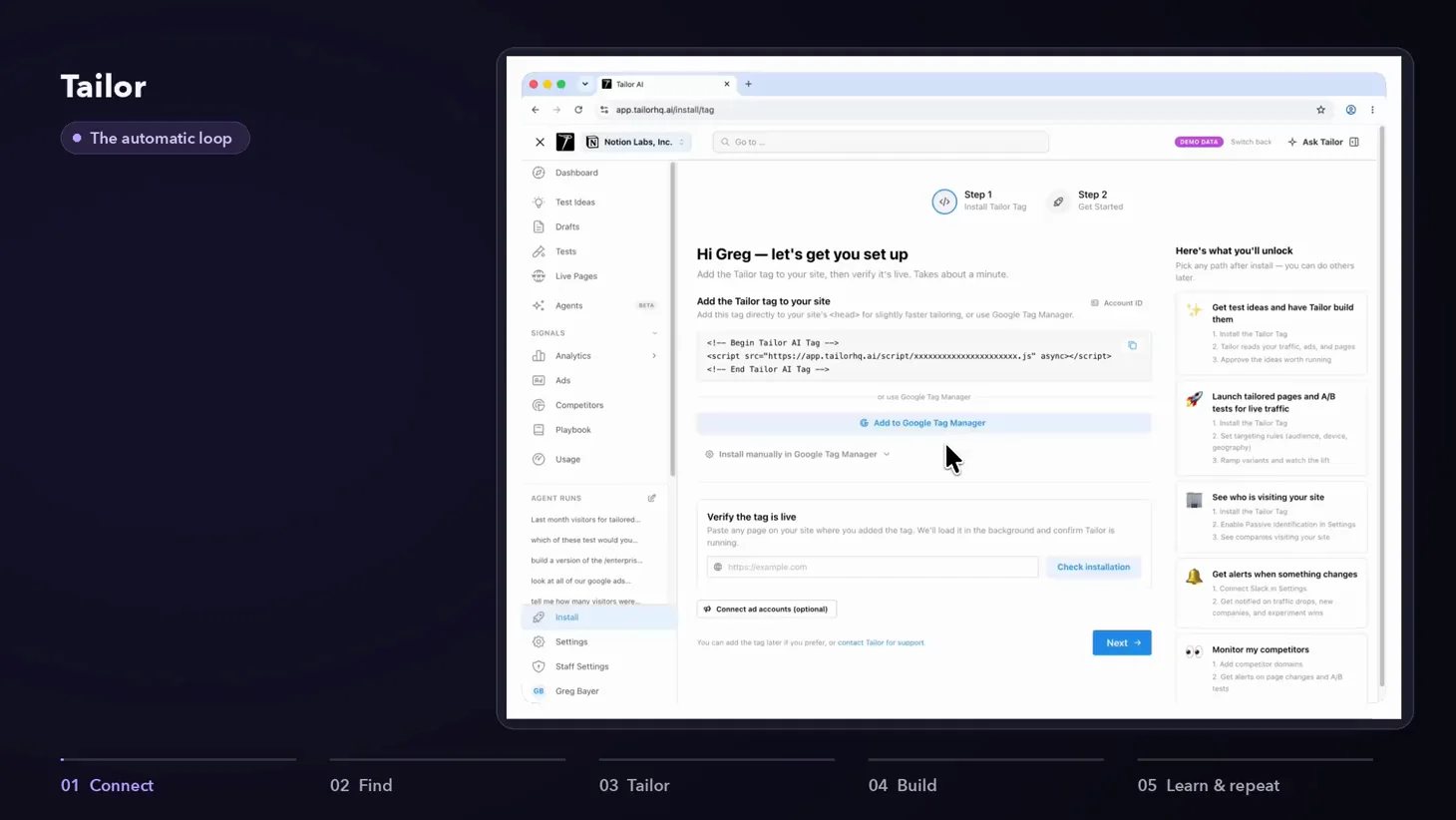
From stages 1-2 to 3: remove the build queue. Install the script, connect your ad accounts, and write a short standing brief about who you are and what you optimize. Agents can then keep a ranked queue of upcoming tests with the variants already built. Your site, analytics, and ad accounts stay where they are.
From stage 3 to 4: automate one decision at a time. Pick the decision that costs the most attention, usually rolling out clear winners or keeping translations in sync. Set the threshold and let it run under that rule. Expand as trust builds.
From stage 4 to 5: manage the program, not the tests. Review the queue weekly instead of each test daily. Judge the program on revenue per segment against spend, and let results teach the next round.
Evidence
The execution gap, in your peers' words
- 1-2 tests
- per quarter at a fully staffed B2B marketing team
- 1-3 weeks
- per landing-page change, gated on one web lead
- 3-6 months
- of backlog to add one tracking metric at an enterprise
- 5 months
- one test ran unattended because nobody stopped it
FAQ
Frequently asked questions
No. Strategy, brand, creative direction, and budget stay human. What changes is who executes: finding gaps, building variants, running tests, and reading results.
Guardrails come before autonomy. Brand voice, approved language, goals, and guidelines feed the agent before it proposes anything, and nothing goes live without approval until you automate a specific decision under thresholds you set.
No. Conditional autonomy is rule-based. You set the rule, every action is logged, and you keep the kill switch.
No. Tailor runs on your existing site, analytics, and ad accounts. Your CMS, page builder, and data stack stay where they are.
Judge it by revenue and conversion per segment against ad spend. Each stage should raise the number of tests shipped and shorten the idea-to-live gap.
Most teams sit at stages 1 and 2. The common constraint is execution capacity, not a shortage of ideas.
Skip the queue. Keep the control.
See what agents would test on your site. You approve what ships.