
Guide · Testing Velocity
Landing page testing without the engineering queue
Every marketing team has a list of experiments they want to run. Most of those experiments never happen because every page change requires a designer, a developer, a staging environment, and a deployment cycle.
This guide covers the patterns teams use to break through that bottleneck and ship tests in minutes instead of weeks, based on what we’ve learned from marketing teams across SaaS, e-commerce, healthcare, and financial services.
By Greg Bayer · Last updated March 1, 2026
 Tailor AI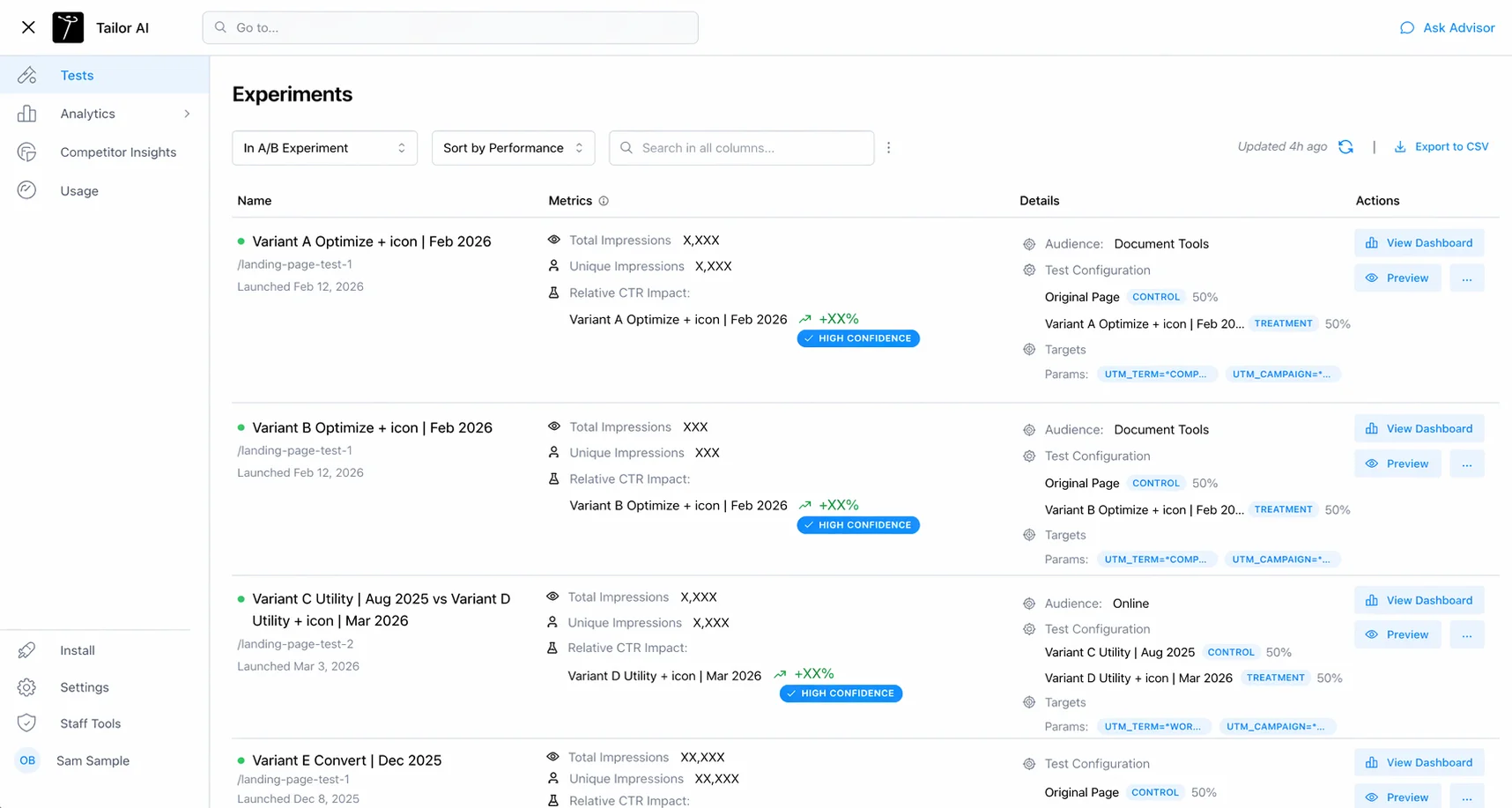
- Who this is for
- Performance marketers and growth teams who have experiment ideas but not the dev capacity to ship them.
- Methodology
- Every marketing team we've talked to has the same bottleneck: getting changes live on the website requires engineering time they don't have. This guide covers how teams break that dependency.
Teams running Tailor






The problem
Why page changes wait in the engineering queue.
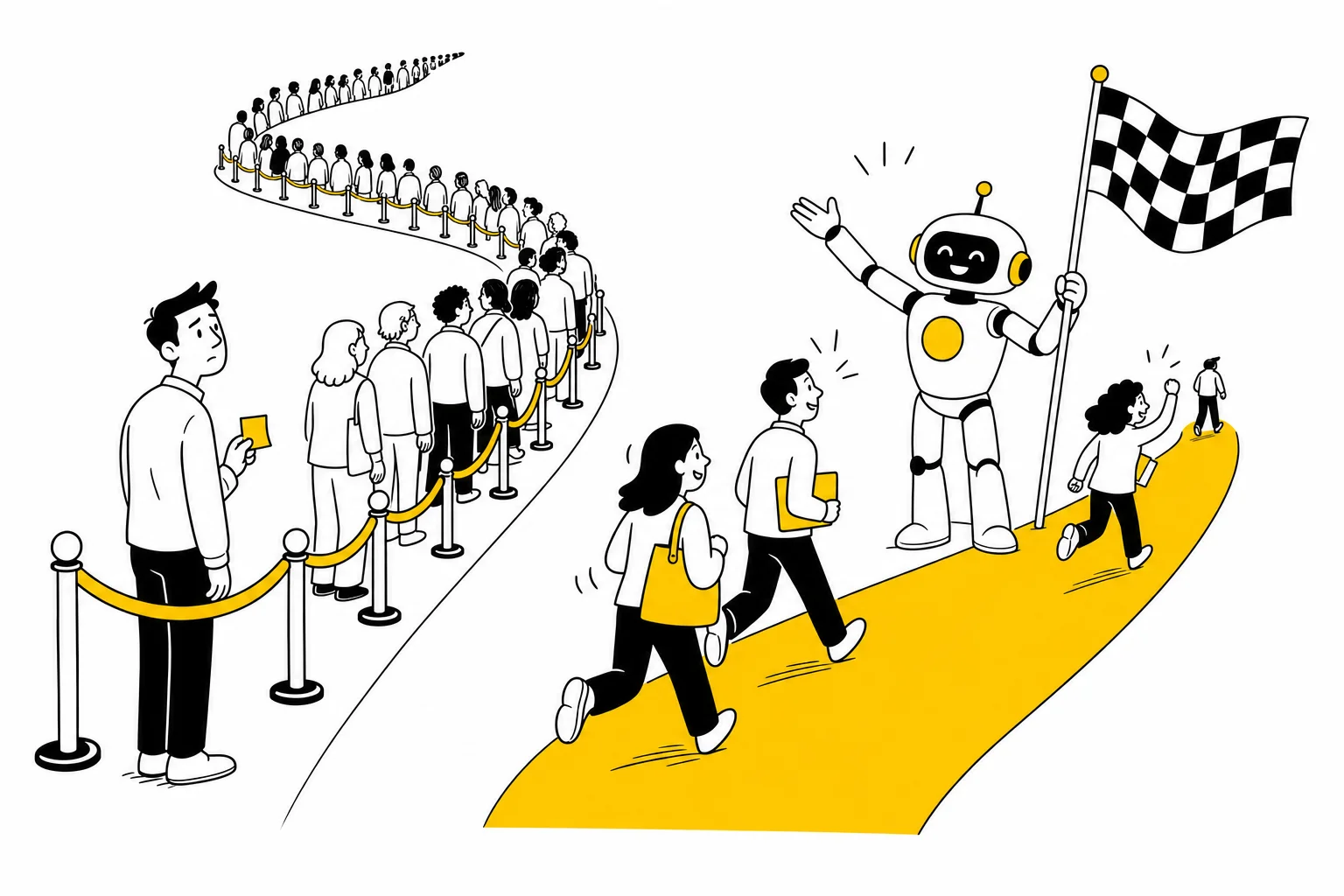
Across every marketing team we’ve spoken with, testing velocity came up more than almost any other pain point. Not strategy. Not budget. Not ideas. The problem is getting changes live.
The typical chain looks like this: idea, brief, design, copy review, development, staging, QA, deploy. That’s 3 to 6 weeks minimum for a single page change. And every step has a queue.
What teams tell us
"I've never seen a landing page go live faster than a month."
"We wanted a Super Bowl landing page and we did not have time."
"All we want to do is test a new hero image on the homepage. And why is this such a huge lift? It's like 15 engineering weeks."
"You don't want to be dependent on your product and eng team on stuff like this. It slows you way down."
"Pretty painful process to spin up web pages."
"Those pages are stuck in a CMS that's difficult to modify."
The pattern repeats everywhere: marketers have experiment ideas, but every change has to compete with product roadmap priorities for engineering time. Most ideas never make it out of a spreadsheet.
When campaigns come together quickly, the landing page becomes the thing that holds everything up. As one growth lead put it: “Speed is number one. We need to be able to move fast.”
Hidden costs
The cost comes from the tests that never run
The obvious cost is dollars: agencies charging thousands per page, internal teams spending weeks on a single variant. But the real cost is opportunity cost. Every week without a test is a week you’re running traffic to an unproven page.
The math teams share with us
- Agency-built pages: 3-week build cycles. One team reported paying $7,000 for four pages.
- Internal production: One team spent close to $50,000 on a single batch of landing pages.
- Copy approval: 3+ days for sign-off from 4 to 5 stakeholders, before a single line of code is written.
- Opportunity cost: "Your greatest cost is the opportunity cost of being able to run a better page."
When a marketer’s time is spent tweaking headings in a CMS instead of creating net new content, the cost compounds. As one team lead told us: “Her time is probably best spent producing net new content rather than updating and tweaking headings.”
The hidden cost is learning velocity. Teams that can’t test frequently can’t learn what works. They end up making decisions based on intuition instead of data. As one frustrated marketer put it: “Your greatest cost is the opportunity cost of being able to run a better page.”
The solution pattern
How teams eliminate the engineering dependency
The teams that move fastest share a common pattern: they decouple page changes from the engineering release cycle entirely. Here’s how it works.
Increasingly you don’t even do the editing: Tailor’s agent finds the test, builds the variant, and launches it. You approve before anything ships.
- 1
Overlay-based editing
Edit live pages directly in the browser. No CMS migration, no staging environment, no deploy queue. Changes go live instantly. The original page structure stays untouched underneath. One team described their reaction: "This beats the former tactic, which was actually creating the pages individually."
- 2
Built-in A/B testing
No separate testing tool needed. Run experiments from the same interface where you make changes. As one growth lead told us: "The ability to split test without having to have a testing tool is huge. Having it all in one is number one."
- 3
One-line installation
Add one JavaScript tag. Marketing owns the rest. Engineering involvement ends after the initial install. "Just one line of JavaScript and it works. That's what I need."
- 4
Non-destructive changes
Your original page is always the fallback. If something goes wrong, the base page shows as-is. No changes to production code, no rollback needed. This is what makes marketing teams comfortable moving fast without a QA cycle.
The shift is simple: instead of building pages from scratch, you modify what already exists. Instead of waiting for a deploy, you publish changes instantly. Instead of managing a separate testing tool, experiments are built into the workflow.
See it in action: watch the browser extension setup video, the page editing walkthrough, and the publishing workflow video.
See how fast you can launch a test
Getting started
What to test first (practical prioritization)
When you finally have the ability to ship tests quickly, the temptation is to test everything. Resist that. Start with tests that are fast to run and give you the clearest signal.
- 1
Headline tests
Fastest, highest signal. Change one headline and measure impact on your primary CTA. If your ad says one thing and your page says another, fix that mismatch first. This alone can move conversion rates meaningfully.
- 2
CTA tests
Change button text, color, or placement. The results are clear and measurable. Low effort, high learning.
- 3
Squeeze page tests
Remove navigation on paid landing pages. Focus visitors on one action. This is one of the highest-impact patterns teams report, because it eliminates the most common exit path.
- 4
Proof point tests
Swap case studies or social proof for different audiences. Show the fintech case study to fintech visitors. Show the healthcare testimonial to healthcare visitors. Relevance drives trust.
- 5
Image tests
Different hero images for different campaigns or audiences. Visual match between ad creative and landing page reinforces the message. When the ad image matches the page image, visitors feel like they landed in the right place.
The iteration mindset
"It's not about how much you're testing, but what you're testing, how smart is the test you're running."
"I would never use a platform without AB testing capability."
Philosophy
What the best teams do differently
Use these practices to choose and evaluate tests.
- Quality over quantity
- “It's not about how much you're testing, but what you're testing, how smart is the test you're running.”Don't over-test. Start with high-confidence, high-impact changes. A single well-chosen headline test beats ten random tweaks.
- Look for big moves
- “We don't want slow tests. We just want to look for big changes.”Early tests should aim for changes large enough to detect quickly with limited traffic. Save micro-optimizations for when you have volume.
- Testing is table stakes
- “I would never use a platform without A/B testing capability.”The ability to test isn't a feature. It's the minimum bar. If you can't measure whether a change helped, you're guessing.
- Measure what matters downstream
- “Your greatest cost is the opportunity cost of being able to run a better page.”Measure downstream outcomes, not just clicks. A 10% lift in CTA clicks means nothing if it doesn't move signups, pipeline, or revenue.
- Small lifts compound
- “10% difference is going to make a huge difference for us.”At scale, even modest improvements in conversion rate translate directly to lower CAC and better ROAS. The math adds up fast.
Statistical guidelines. Wait for at least 50 CTA clicks before drawing conclusions. For lower-traffic pages, use Bayesian methods to get directional signal faster. Treat 89 to 94% confidence as actionable for most marketing tests. And never let a test run so long that a design change breaks it mid-flight.
Before pushing changes live, use QA preview links to verify the experience looks right on every device.
FAQ
Frequently asked questions
With an overlay-based approach, most teams launch their first test within minutes of installation. The bottleneck shifts from engineering capacity to marketing decision-making.
No. Once the script is installed (a one-time setup that takes minutes), marketers can create, launch, and measure experiments independently.
Overlay-based tools are non-destructive. Your original page is always the fallback. If the adaptation fails to load, visitors see your default page as-is.
A practical guideline: wait for at least 50 clicks on your primary CTA before drawing conclusions. For lower-traffic pages, use directional testing with shorter windows.
Start with big, high-confidence changes (headline match, squeeze page). Small optimizations matter at scale, but early tests should focus on changes large enough to detect quickly.
Google Optimize shut down in September 2023. Many teams have been without a testing tool since. The pattern described in this guide works with any overlay-based testing approach.
Launch a page experiment from your existing site.
Stop waiting on dev queues. See how fast your team can go from idea to live test.