
Use case · B2C
Your site tells one story even though every campaign sells a different reason to buy
B2C traffic doesn’t come with a company name attached, but it carries plenty of signal: the campaign and keyword that brought the click, the creative they saw, their device, their location, their language, and whether they’ve been here before. Tailor turns those signals into tailored page experiences and measures the lift on trials, subscriptions, and leads.
Connect your ad accounts so Tailor can propose and build page tests for approval.
Last updated July 26, 2026
 Tailor AI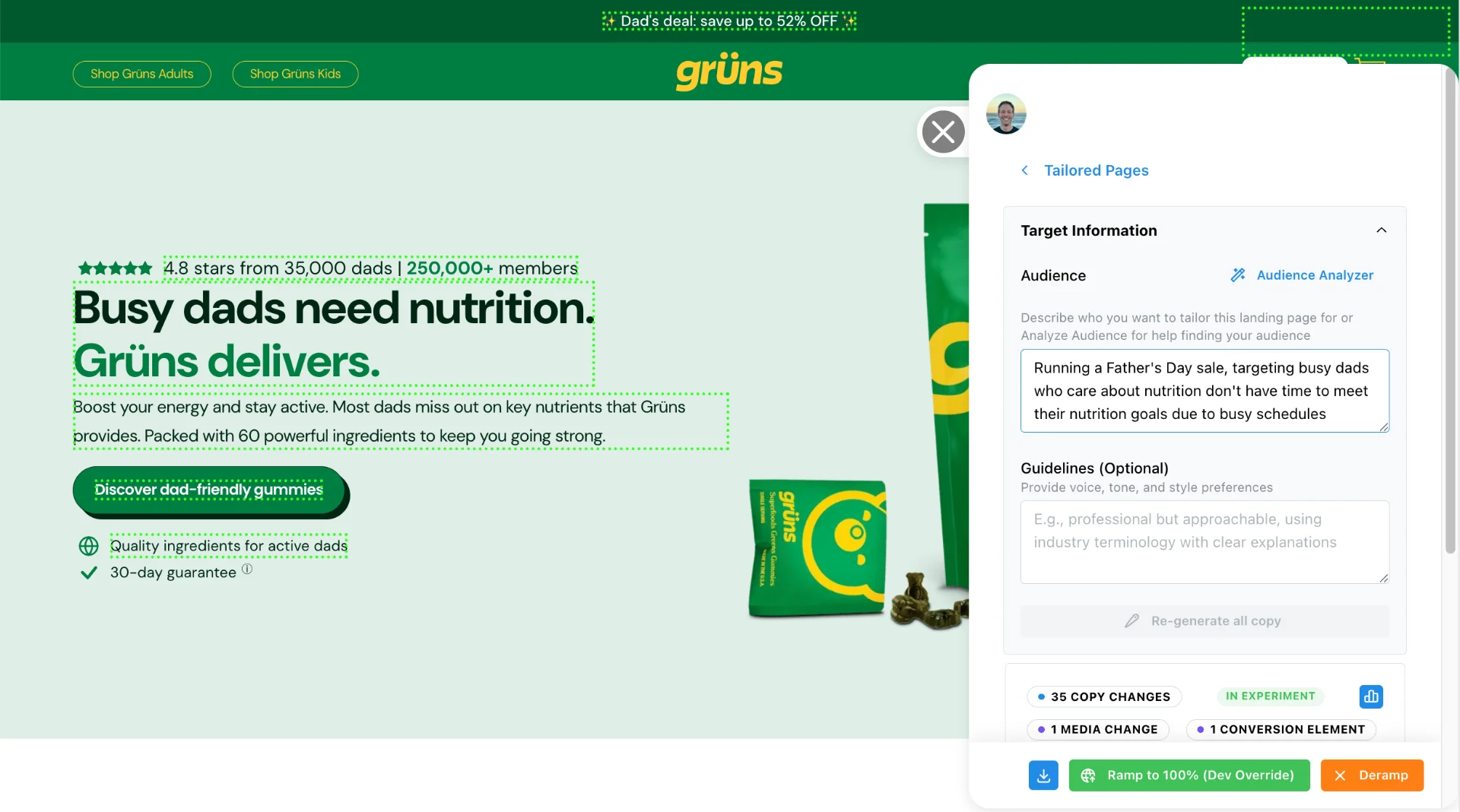
- Built for
- Subscription apps, consumer services, marketplaces, and lead-gen businesses running paid traffic.
- Covers
- The B2C signal set, subscription and lead-gen patterns, the automatic loop, measurement, and honest constraints.
Teams running Tailor






The problem
You segment your ads carefully, then send every segment to the same page.
B2C teams run dozens of campaigns at once: brand vs. non-brand search, competitor terms, prospecting and retargeting audiences, seasonal pushes. Each one attracts a visitor with a different reason to care. The ad platforms know this; that’s why you write different ads for each. The landing page usually doesn’t, because building and maintaining a page per campaign is more work than any team can sustain.
Check whether each campaign lands on a page that addresses its offer.
With high B2C traffic volumes, even small per-segment conversion gains compound quickly, and the same volume means experiments reach significance in days rather than weeks.
How it works
The B2C signal set: no company data required
B2B personalization leans on company enrichment. B2C visitors browse from residential IPs, so Tailor uses the signals that actually exist for consumer traffic. Each one can drive a tailored experience, alone or combined.
- Campaign and keyword
- The utm_campaign and utm_term on the click. The strongest intent signal you have: it says what the visitor was promised.
- Ad creative
- utm_content identifies which ad variation they clicked, so the page can continue that creative's angle.
- Device
- Mobile visitors convert differently. Adapt CTAs, layout emphasis, and app-install prompts by device.
- Geography and language
- Country and language adapt offers, currency framing, social proof, and whole-page translation.
- New vs. returning
- Test separate messages for first-time and returning visitors.
- Custom signals
- Define your own yes/no signals (like logged-in status) in Settings and target by them like any built-in.
Full details in the targeting guide. Tailor’s agent can also find the gaps and build the tests for you; see Test Ideas.
Patterns
Common B2C patterns
Two families show up again and again: subscription conversion and lead generation. The signals are the same; the goals differ.
- Subscription: match the page to the search intent
- A meditation app buying "meditation for sleep," "meditation for beginners," and "best meditation app" is buying three different customers. Swap the hero headline, subhead, and proof per keyword theme so each visitor sees their reason to start a trial. This is the highest-impact B2C pattern because paid search terms state intent explicitly.
- Lead gen: carry the ad promise to the form
- For lead-gen businesses (real estate, insurance, home services, education), the conversion is a form fill, and cost per lead is the scoreboard. The pattern: mirror the ad’s specific promise in the headline above the form, keep the form visible on mobile, and test proof elements per campaign audience. Marketplaces like PropertyGuru run this playbook across high-volume consumer traffic.
- Prospecting vs. retargeting
- Prospecting traffic has never heard of you; retargeting traffic has. Show first-time visitors the category pitch and social proof. Show returning visitors what's changed, the offer, or the next step, instead of repeating the same pitch they already didn't convert on.
- Device and market adaptation
- Mobile-heavy consumer traffic often deserves different emphasis: shorter pages, sticky CTAs, app-store buttons where relevant. Combine with geography for market-specific offers and whole-page translation for non-English traffic. See localization and device for the full pattern.
Agentic marketing
The loop runs across your whole site
The patterns above describe individual plays. The reason they add up to a program is that Tailor runs the loop for you, across every page your campaigns touch.
- 1
Scan
Install the script and connect your ad accounts. Tailor reads your campaigns, keywords, spend, and every landing page they point to, and finds where the message match is weak.
- 2
Propose
It keeps a standing queue of upcoming tests ranked by expected impact, each with the audience, the page changes, and a before/after preview already built.
- 3
Build and launch
Tailor builds the variants itself: headlines, copy, new elements, whole-page translations. You approve, and it goes live on your existing URLs as an A/B test, or ramps straight to everyone when you're confident.
- 4
Learn and iterate
Use completed test results to refine the next recommendations.
See Test Ideas for how the queue works, and Tailor Agent for what the agent can build.
See what Tailor would test on your site
Free scan of your live ads and pages. No install, no meeting.
Measurement
Measured on trials, subscriptions, and leads
Every tailored experience runs as an A/B test against your default page. Pick the goal that matches your business: trial starts, subscription checkouts, form submissions, or revenue. Results come back per segment, so you can see which specific audience a change helped, and by how much, before you roll it out.
For subscription businesses, connect your analytics (GA4, Amplitude) to measure past the signup into activation and retained subscribers. For lead gen, form-submission goals track cost per lead by campaign and segment. Revenue goals support any currency.
Setup details in conversion goals and sending events to analytics.
Limitations
What to expect (honestly)
- Company enrichment won't help you here
- IP-based company identification works on commercial networks. Consumer traffic comes from residential IPs, so B2C personalization runs on campaign, device, geo, language, and behavior signals instead. That's why this page and the B2B page describe different playbooks.
- Campaign targeting is only as good as your URL hygiene
- If your ads don't pass UTM parameters consistently, campaign and keyword targeting has nothing to read. Fix tracking templates first; it usually takes minutes in the ad platform.
- Niche segments still need traffic
- High-traffic B2C sites reach significance fast, but a segment that gets 50 visitors a week doesn't. For small segments, test bigger changes or broaden the segment definition.
- Personalization amplifies a working funnel; it doesn't fix a broken one
- If the offer is wrong or the product page can't close, message match moves the needle less. Start where intent is clearest and traffic is largest, usually your top paid search terms.
FAQ
Frequently asked questions
B2B personalization leans on company enrichment (industry, company size, target accounts). B2C visitors browse from residential IPs, so the useful signals are different: campaign, keyword, ad creative, device, geography, language, and new vs. returning. Tailor supports both; this page covers the B2C signal set.
For campaign and keyword targeting, yes. Your ad platform should pass utm_campaign, utm_content, and utm_term (most tracking templates already do). Device, geography, language, and new vs. returning targeting work without any URL parameters.
No. Recommendation engines pick which products to show from your catalog. Tailor adapts the page experience itself (headlines, offers, proof, CTAs) per audience segment, and measures the impact with per-segment experiments. The two are complementary.
High traffic is an advantage: experiments reach significance in days rather than weeks, so you can iterate quickly. With low order values the wins come from volume, so tie experiments to conversion rate and revenue per visitor rather than one-off purchases.
Tailor loads asynchronously and search engines see your original page structure unchanged. Tailored experiences target ad traffic segments, so organic visitors and crawlers get your default page. See the SEO and cloaking docs for details.
No. With the script installed and your ad accounts connected, Tailor proposes personalizations and page improvements across your whole site, builds the variants, and launches them as tests once you approve. It learns from each result and keeps the queue of upcoming tests filled, so the program compounds instead of depending on someone building each page by hand.
Every tailored experience runs as an A/B test against your default page, measured on the conversion goal you choose: trial starts, subscriptions, leads, or revenue. Results break down by segment, so you can see exactly which audience the change helped.
Use campaign context to choose a relevant page variant.
Let your pages act on it. See what Tailor would change on your site.
PropertyGuru raised click-through 69% on its guide pages by changing what sits above the fold.
Read the PropertyGuru case study