
Guide · Measurement
How to measure landing page impact beyond clicks
Most teams can increase CTR or page conversion rate. The problem is proving that those changes drove real business outcomes: trials, pipeline, revenue. This guide covers the measurement framework that connects landing page experiments to the numbers your leadership team actually cares about.
By Greg Bayer · Last updated March 1, 2026
 Tailor AI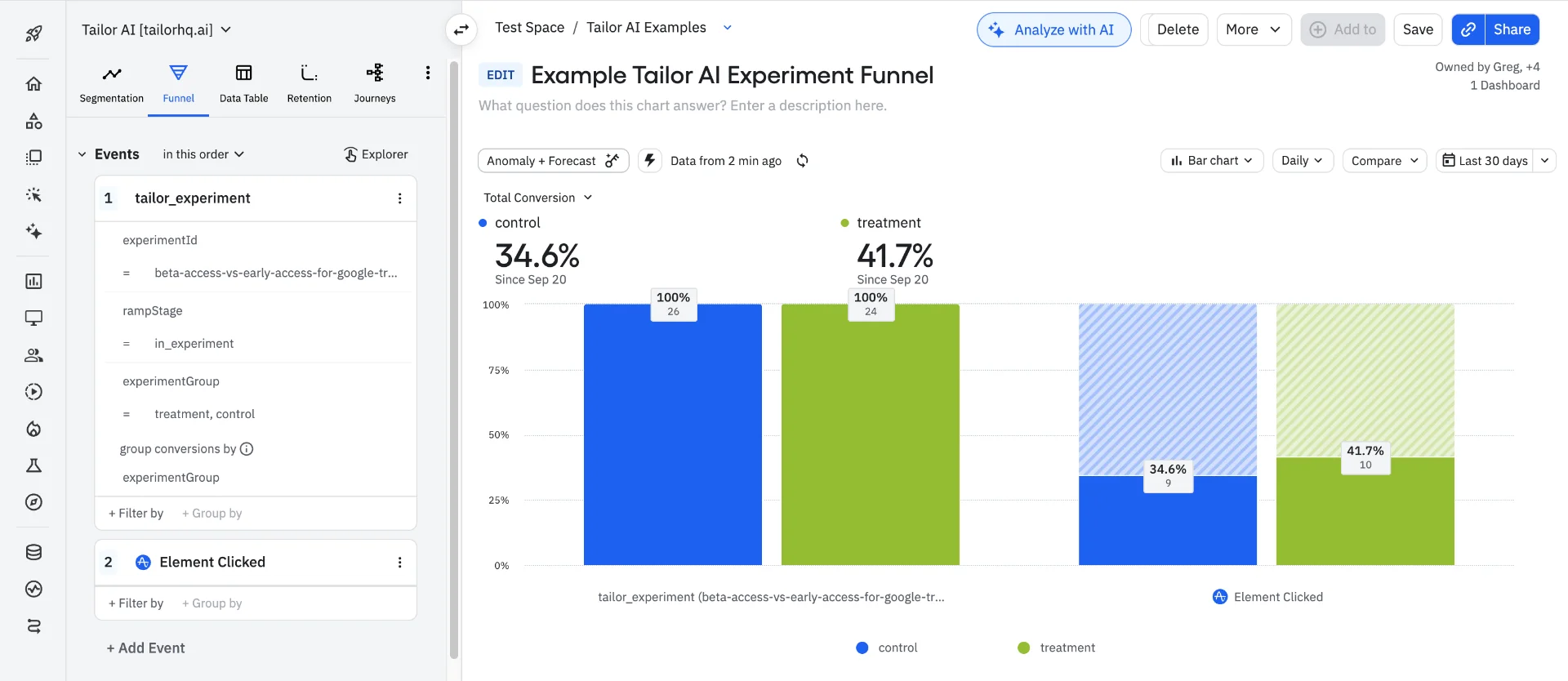
- Who this is for
- Growth teams, performance marketers, and CRO managers who need to prove that landing page work drives downstream revenue.
- Methodology
- Most teams can tell you their conversion rate. Fewer can connect a landing page experiment to pipeline dollars. This guide covers the measurement patterns that bridge that gap.
Teams running Tailor






The gap
The measurement problem
Optimization tools show clicks and conversion rates. Leadership asks about pipeline and revenue. This disconnect kills landing page investment before it starts.
The biggest barrier to landing page investment is not the cost of the tools or the effort of running tests. It is the inability to prove ROI in terms the business actually uses.
"I can get the data, but putting it in front of the right person at the right time is a whole separate problem."
"Your job is to make the marketer look amazing in some way that is provable inside the door."

One frustration comes up more than any other: teams know their landing pages are underperforming, but they cannot justify the investment because the results live in the wrong place.
"Nobody really cares about landing pages because they can't prove the mid-funnel matters."
"Analytics and alerting pain is bigger than landing page pain for us."
And even when teams do get measurement working, interpretation is the next bottleneck.
"I can see the conversion rate went up. But I can't tell you whether that turned into pipeline or just more unqualified leads."
Framework
The measurement hierarchy
Connect page engagement and conversion data to qualified leads, pipeline, and revenue.
Engagement
Clicks, scroll depth, time on page
Use engagement metrics to diagnose behavior and conversion metrics to judge outcomes.
Page conversion
Form fills, CTA clicks, signup starts
Track form submissions and signup starts.
Downstream conversion
Trial starts, demo requests, qualified leads
Connect test variants to trial starts, demo requests, and qualified leads.
Pipeline
Opportunities created, deal stages advanced
Connect CRM data to measure opportunities and deal progress.
Revenue
Closed won, ARPU/ARPV, payback period
Measure closed revenue when you can connect it to experiment variants.
Most teams measure levels 1-2 well. Level 3 is where experiments stop getting credit. Levels 4-5 are where leadership decisions happen.
"If you can even remove a little bit of friction from that experience, you can convert that traffic a lot more effectively."
The practical implication: if your experiment results only show page-level metrics, you are asking leadership to trust that those metrics matter. If you show pipeline impact, they can calculate the value themselves. Start by defining the right conversion goals so you are measuring the events that actually map to business outcomes.
Where results need to live
Integration patterns
Experiment results only matter if they show up where decisions are made. Here is where that typically happens.
GA4
Universal but often confusing. Many teams have GA4 installed but don't meaningfully use it for experiment analysis.
"We don't meaningfully have access or have GA4 incorporated into our workflow."
Amplitude
Used by product-led growth companies. Experiment data needs to show up here because this is where product and growth teams already look.
"We need this data in Amplitude. That's where product reviews happen."
Google Ads
Closes the loop from ad click to experiment to conversion. Critical for teams optimizing ROAS, but setup is painful.
"Setting up conversion goals for Google Ads is a huge pain."
Segment
Data foundation for some companies. Pipes events to multiple destinations so experiment data flows everywhere automatically.
CRM (Salesforce, HubSpot)
For B2B pipeline attribution. Ties experiment variants to deals so you can answer: which experiment drove this pipeline?
"The analytics needs to be less manual. We should be able to just pull it up and see what's happening."
"I think you're in the business of improving revenue or conversion. I don't think the customers care how you do that."
For a step-by-step walkthrough of connecting your analytics tools, see the analytics platform integration guide.
See experiment results in your existing dashboards
Internal buy-in
Proving impact to leadership
Report experiment results in the terms your stakeholders use to make decisions.
- Show results where leadership already looks
- Put experiment results in the dashboards used for weekly decisions.
- Frame results in dollars
- A 10% conversion lift on $50K/month ad spend is roughly $5K/month in recovered value. Leadership does not care about percentage lifts. They care about money.
- Run longer tests that capture downstream events
- Page clicks resolve in hours. Trial-to-activation takes days or weeks. Revenue attribution takes longer. If you call a test after 48 hours, you are measuring the wrong thing.
- Build a quarterly narrative
- X experiments run, Y winners, Z% lift in the metric leadership cares about. A running record of velocity and learning compounds credibility over time.
- Report what each experiment taught you.
- The insights from losing experiments are often more valuable than the lift from winners. A test that reveals which message resonates with enterprise buyers is worth more than a 3% CTR bump.
"I think you're in the business of improving revenue or conversion. I don't think the customers care how you do that."
The teams that sustain landing page investment are the ones that tie every experiment to a business outcome. Not because leadership demands it, but because that framing protects budget when priorities shift.
Getting the numbers right
Statistical rigor (practical version)
You do not need a statistics PhD to run meaningful experiments. But you do need guardrails to avoid wasting time on noise.
- 1
Wait for 50+ CTA clicks before drawing conclusions
Below this threshold, random variation dominates. A single outlier session can swing results 20%.
- 2
89-94% confidence is actionable for most marketing decisions
You are not running clinical trials. If a variant is directionally better at 90% confidence and the downside is small, ship it.
- 3
Use Bayesian methods for smaller sample sizes
Frequentist approaches need large samples to be reliable. Bayesian methods give you useful directional signals earlier.
- 4
Low-traffic B2B sites: directional testing beats no testing
If you only get 500 visitors a month, you will never reach 95% confidence on a 5% lift. Test bigger changes and use the data directionally.
- 5
Don't let long tests get broken by design changes
A 3-month test that gets invalidated by a homepage redesign in week 6 is wasted effort. Coordinate with your design team or scope tests tightly.
"If you were to give someone a black box and say, after implementation, your conversion from landing pages will be up 20%, and also we will give you the messaging that works, is that not the same thing?"
Avoid vanity metrics. If the metric would not change a budget decision, it is not worth reporting. Measure what leadership will act on. For a walkthrough of setting up and running experiments, see the experiments workflow guide.
FAQ
Frequently asked questions
Fire experiment variant data into your analytics platform (GA4, Amplitude, Segment). Tag visitors with experiment IDs that persist through the funnel. When a visitor converts to a lead or opportunity, the experiment attribution carries forward into your CRM.
Lead with the metric they already track: CPA, ROAS, pipeline velocity, or revenue. Frame experiment results as incremental impact on that metric. Avoid reporting page-level metrics like CTR unless leadership specifically asks for them.
Long enough to capture downstream conversions, not just page clicks. For SaaS with 14-day trials, run experiments for at least 3-4 weeks. For e-commerce with same-session purchases, a few days of sufficient traffic may be enough.
Use Bayesian methods, which work better with smaller samples. Focus on high-impact changes that produce large, detectable differences. Directional data from small tests is better than no data at all.
Both, but GA4 (or Amplitude) should be the primary view. That is where your team already looks. A separate dashboard can provide deeper analysis, but the headline results need to be where decisions happen.
Prove that your page work drives revenue.
See how experiment results flow into the dashboards your team already uses.