
Guide
Landing Page Optimization: A Practical Guide for Paid Traffic
Landing page optimization is how you get more customers from the ad spend you already have. Most paid teams pour their energy into bids, audiences, and creative, then send all of it to pages that haven’t changed in months. This guide covers which page elements actually move conversion, why one page can’t be optimal for every campaign, and what changed now that the whole optimize-test-learn loop can run automatically.
By Tailor AI team · Last updated July 20, 2026
 Tailor AI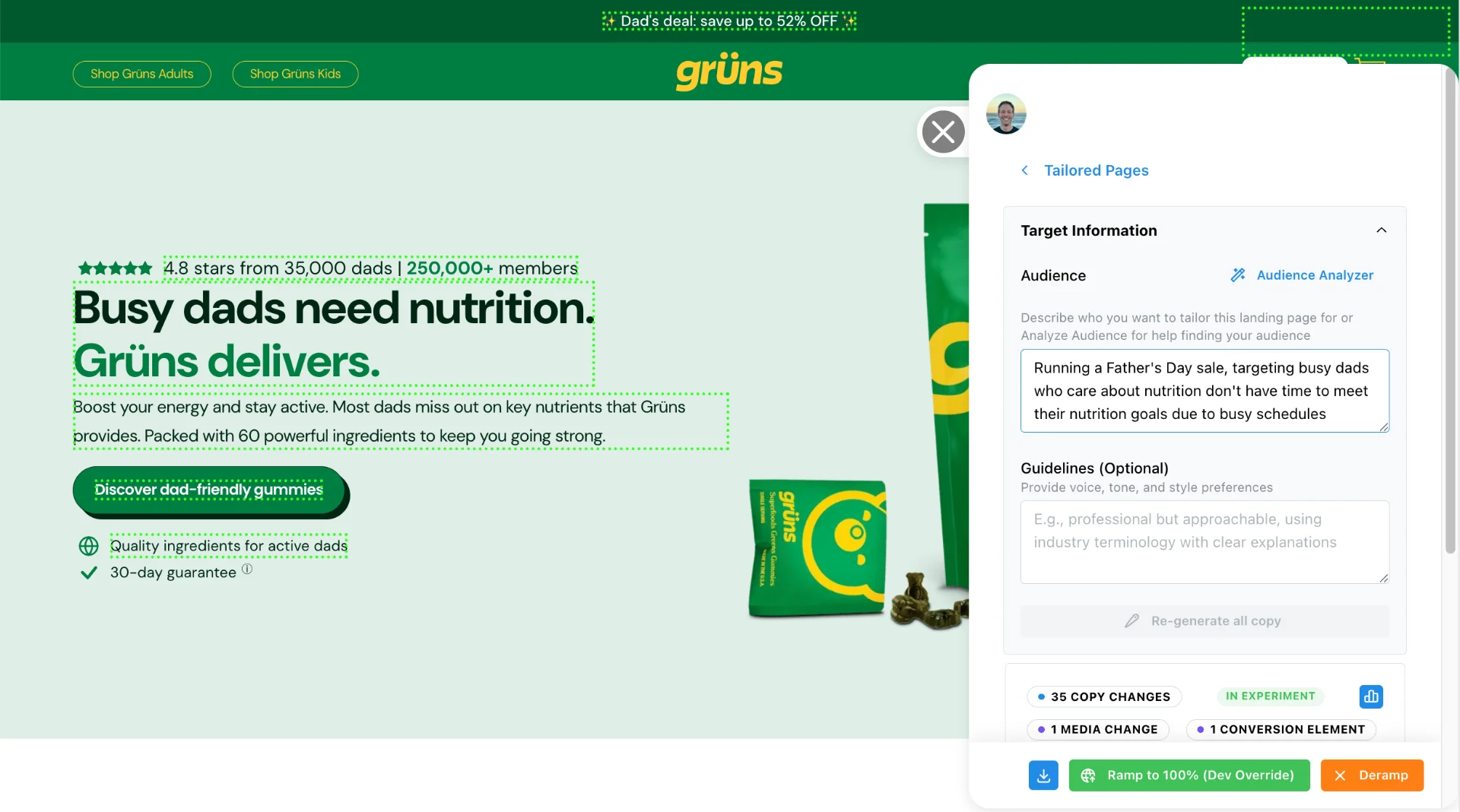
- Who this is for
- Performance marketers and growth teams running paid campaigns who own the conversion outcomes on the pages behind that spend and want a practical way to improve them.
- Methodology
- Drawn from hundreds of conversations with paid acquisition teams about how they optimize landing pages, what blocks them, and what actually moved their numbers. No invented statistics, just patterns that repeat.
Teams running Tailor





Definitions
What is landing page optimization?
Evaluate page changes against a conversion baseline.
It’s a sibling of conversion rate optimization, and the relationship is simple: this is CRO applied to the pages behind your campaigns. Same discipline, narrower surface, faster payoff, because those pages sit directly behind money you’re spending every day. The full discipline, including research methods and testing statistics, is covered in our conversion rate optimization guide.

Why it beats buying more traffic
The math is the whole argument. Say a campaign spends $10,000 a month, sends 5,000 clicks to a landing page, and the page converts at 2%. That’s 100 conversions at $100 each. You have two ways to get to 150 conversions. Option one: raise spend 50%, to $15,000, and hope your marginal clicks cost the same as your average ones (they won’t, auctions get more expensive as you scale). Option two: get the page from 2% to 3%. Same spend, same clicks, 50 more conversions, and your cost per conversion drops to $67.
That’s why landing page optimization is usually the cheapest lever in paid acquisition. Every point of landing page conversion flows straight into your unit economics, and unlike bids and budgets, page improvements compound: a better page converts better for every campaign you point at it, this month and next. When someone asks how to increase conversion rate without increasing budget, this is the answer. The page is where the upside sits, and it’s the part of the funnel most paid teams touch least.
Prioritization
The elements that actually move conversion
Prioritize tests by expected impact and the evidence available for each change.
- 1. Headline and message match
- The headline is the highest-traffic element on the page. Everyone reads it, and it decides in seconds whether the visitor feels understood. The test that matters most: does the headline continue the promise of the ad, keyword, or post that brought the visitor here? A generic headline in front of specific intent is the single most common conversion leak on paid landing pages.
- 2. CTA commitment level
- Test what you're asking for before you test how the button looks. A visitor comparing options may not be ready to book a demo but will happily see pricing or watch a two-minute tour. High-intent branded traffic can take a direct ask. Colder traffic converts better on a smaller step. The commitment level of the CTA is a message decision, not a design decision.
- 3. Proof placement
- Logos, case studies, testimonials, and numbers answer the visitor's real question: did this work for someone like me? Placement beats volume. Proof buried below the fold does nothing at the moment of decision, and a single case study from the visitor's industry next to the CTA usually outperforms a wall of generic logos at the bottom of the page.
- 4. Forms
- Every field is a toll. Cut the fields your sales team doesn't actually use, move optional questions to after the conversion, and consider multi-step forms that capture the email early. Forms are where high-intent visitors get lost over details, which makes them cheap wins once the message is right.
- 5. Page speed
- Slow pages lose visitors before any of the above gets a chance to work, and mobile paid traffic feels it worst. Speed is a prerequisite, not a differentiator: get the page fast enough that it isn't the problem, then spend your testing energy on message and offer, where the real lifts live.
Start with message, offer, proof, and form-friction tests.
This ordering is also the honest version of landing page best practices: message match first, one clear CTA at the right commitment level, proof near the decision, short forms, fast load. Every credible list converges on roughly this, because it’s what visitor behavior keeps rewarding.
The core argument
One page can't be optimal for everyone
Compare results by campaign before choosing one variant for all traffic.
It can’t. A visitor from a branded search is close to converting. A visitor from a cold LinkedIn campaign barely knows what you do. A mobile visitor in another country faces a different form, a different currency, and a different context. When you optimize one page against the average of those visitors, you get a page that’s a compromise for all of them and right for none of them. A variant that wins by 5% overall might be winning 30% with paid search visitors and losing with everyone else, and the blended number hides both facts.
The implication: Evaluate page variants separately for audience segments with enough traffic. Campaign, keyword, source, device, geography, and for B2B, enriched company attributes like industry and size each carry different intent and deserve their own best experience. This is where high converting landing pages actually come from: not one perfect page, but the right variant in front of each audience. The full argument, including why site-wide averages mislead and what each signal tells you, is in the conversion rate optimization guide, and the B2B enrichment angle is covered in AI landing page personalization.
The practical objection is obvious: nobody has time to optimize landing pages per segment by hand. Twenty campaigns times three audiences times two devices is more variants than any team can brief, build, and maintain. That objection was valid for years. The rest of this guide is about why it isn’t anymore.
Where to start.
Ad-to-page match: where to start with paid traffic
If you run paid campaigns and want the single optimization play with the fastest payoff, it’s matching the page to the ad. Every ad click arrives with a promise: the headline the visitor just read, the keyword they searched, the creative that stopped their scroll. When the landing page opens with a generic message instead of continuing that promise, visitors bounce. On Google, the mismatch costs you twice, because poor ad-to-page relevance can also depress Quality Score and raise your CPC.
The reason this play is so underused is scale. Teams run dozens or hundreds of ad variants into a handful of pages, because building a matched page for every ad group was never realistic. Automatic ad-to-page matching removes that constraint: the ad’s message becomes the page headline per campaign or keyword, so hundreds of ad variants each land on a page that continues their specific conversation, without anyone building hundreds of pages.
The full playbook, including channel-specific steps, is in the ad-to-page playbook. For the search version, where keyword intent does the targeting for you, see Google Ads landing pages. For paid social, where the creative carries the promise instead of the keyword, see Meta ads landing pages.
See what Tailor would test on your landing pages
Get segment-level test ideas for your own pages in minutes. Or read how A/B testing and analytics works.
The loop
The process, without a dev queue
The classic way to optimize landing pages runs through engineering: brief, design, build, QA, deploy. Teams consistently describe 2-4 week cycles to get a single variant live, which caps even a disciplined program at a dozen or so tests a year on its most important pages. The ad side of the funnel iterates daily. The page side moves at a fraction of that speed, and the gap is where paid budgets leak.
The modern process removes engineering from the critical path. It looks like this:
- 1. Edit in place
- Change the headline, CTA, proof, or images directly on the live page, in the browser. The variant exists as a layer on the page you already have, so there's no rebuild, no ticket, and no sprint, and search engines see the original page structure unchanged.
- 2. Target
- Point each variant at the traffic it's for: a campaign, a keyword group, a source, a device, a geography, or an enriched company attribute. This is what turns one page into the right page for each segment without multiplying the pages you maintain.
- 3. Test
- Run the variant against the current page for that segment, with a conversion metric picked before launch. Because launching costs minutes instead of weeks, you can afford to test per segment instead of shipping one compromise for everyone.
- 4. Learn and repeat
- Read results per segment, promote winners, retire losers, and feed what you learned into the next round. Velocity is the point: a steady cadence of small, clear tests beats an occasional big redesign every time.
The automatic version
That loop still needs someone to come up with the tests, build each variant, and keep the whole thing running when the quarter gets busy. The next step removes that too. Tailor’s agent watches how each segment behaves on your pages, finds the test worth running, builds the variant, and launches it on your approval. Nothing ships without your sign-off, but the parts that used to stall the program (ideas, builds, follow-through) run on their own, and the results come back per segment.
One SEM lead described the end state before we showed him anything, while thinking out loud about what continuous optimization across a large paid search account would even look like:
“There’d be like a lot of A/B tests running across all terms mapping to all URLs, and then there would be some champion... And then would it like continue to just kind of run on a loop where it’s like, always re-reviewing?”
Use agents to manage tests across terms and URLs, with human approval before launch.
Proving it works
Measuring landing page optimization
Choose a primary conversion goal before launch and use clicks as a diagnostic.
Then push measurement one layer deeper. Per-variant pipeline and revenue take longer to accumulate, but they catch the failure mode conversions miss: pages that convert more visitors into worse customers. Track them per experiment, and make sure UTM parameters and experiment IDs survive the full journey from ad click to CRM record, because a variant label dropped at the form handoff means you can never connect a test to the revenue it produced. The full method, including long B2B sales cycles, is in measuring landing page impact beyond clicks.
On low traffic: classical A/B testing at high confidence needs roughly 1,000 conversions per variant, which puts textbook significance out of reach for many B2B pages, and per-segment testing multiplies the requirement. Choose a test design that fits the available traffic and report its limitations. Test bigger changes, use Bayesian and directional reads for reversible marketing decisions, and let ML-based traffic allocation handle low-volume segments continuously. The specific cutoffs, and when automation beats manual testing, are in traffic thresholds: when to experiment vs. automate. For how per-segment results and anomalies surface in practice, see A/B testing and analytics.
FAQ
Frequently asked questions
Landing page optimization is the practice of improving the pages behind your campaigns so more of the visitors you pay for actually convert: start a trial, book a demo, buy, or fill out a form. It covers the message, the offer, the proof, the form, and the speed of the page, all measured against a baseline so you know whether a change helped. Done well, it's a continuous loop of testing and learning, not a one-time redesign.
Landing page optimization is conversion rate optimization applied to a specific surface: the pages behind your campaigns. CRO is the broader discipline of researching, hypothesizing, and testing anywhere conversions happen, including checkout flows, pricing pages, and in-product steps. If you run paid traffic, the pages behind your campaigns are usually where CRO pays off fastest, because every point of conversion rate there flows straight into your cost per acquisition. Our conversion rate optimization guide covers the full discipline.
The headline, specifically how well it matches what brought the visitor there. For paid traffic that means matching the ad's promise or the keyword's intent. Headline tests are fast to build, touch every visitor, and produce the clearest reads. After the headline: the CTA's commitment level, proof placement near the decision point, form length, and page speed. Prioritize by spend, and fix the pages behind your most expensive traffic first.
Start with message match: the page headline should continue the promise of the ad and the keyword that triggered it. Mismatch costs you twice on Google, once in bounces and once in Quality Score, which raises your CPC. Map your highest-spend keywords to headlines that speak to their specific intent, keep one clear CTA that matches the intent level, and measure per campaign and keyword rather than one blended rate. Automatic ad-to-page matching does this per keyword without building hundreds of pages.
The practices that consistently hold up: match the message to what the visitor clicked, offer one clear CTA at the right commitment level, place proof near the decision point, keep forms as short as sales actually needs, and load fast on mobile. The one most teams miss is per-segment relevance: a page that's right for a branded search visitor is usually wrong for a cold social visitor, so the best pages adapt to the traffic instead of averaging across it.
Work the page side of the funnel. To increase conversion rate on existing traffic, fix message match on the pages behind your biggest spend, lower the commitment level of the CTA for colder segments, move proof next to the decision, cut form fields nobody uses, and test per segment instead of shipping one page for everyone. Every one of those changes raises conversions from the visitors you already pay for, which is cheaper than buying more of them.
No. Rebuilds are the most expensive and slowest way to optimize, and they reset your learning every time. The modern approach adapts the page you already have: variants exist as a layer on the live page, so you can change the headline, CTA, proof, or images per segment without touching the underlying code or waiting on a dev queue. Search engines see the original structure unchanged, and you keep your baseline intact.
Optimize every landing page, per segment, automatically.
Tailor finds the test, builds the variant, and launches on your approval. Results come back per segment, tied to conversions and revenue.