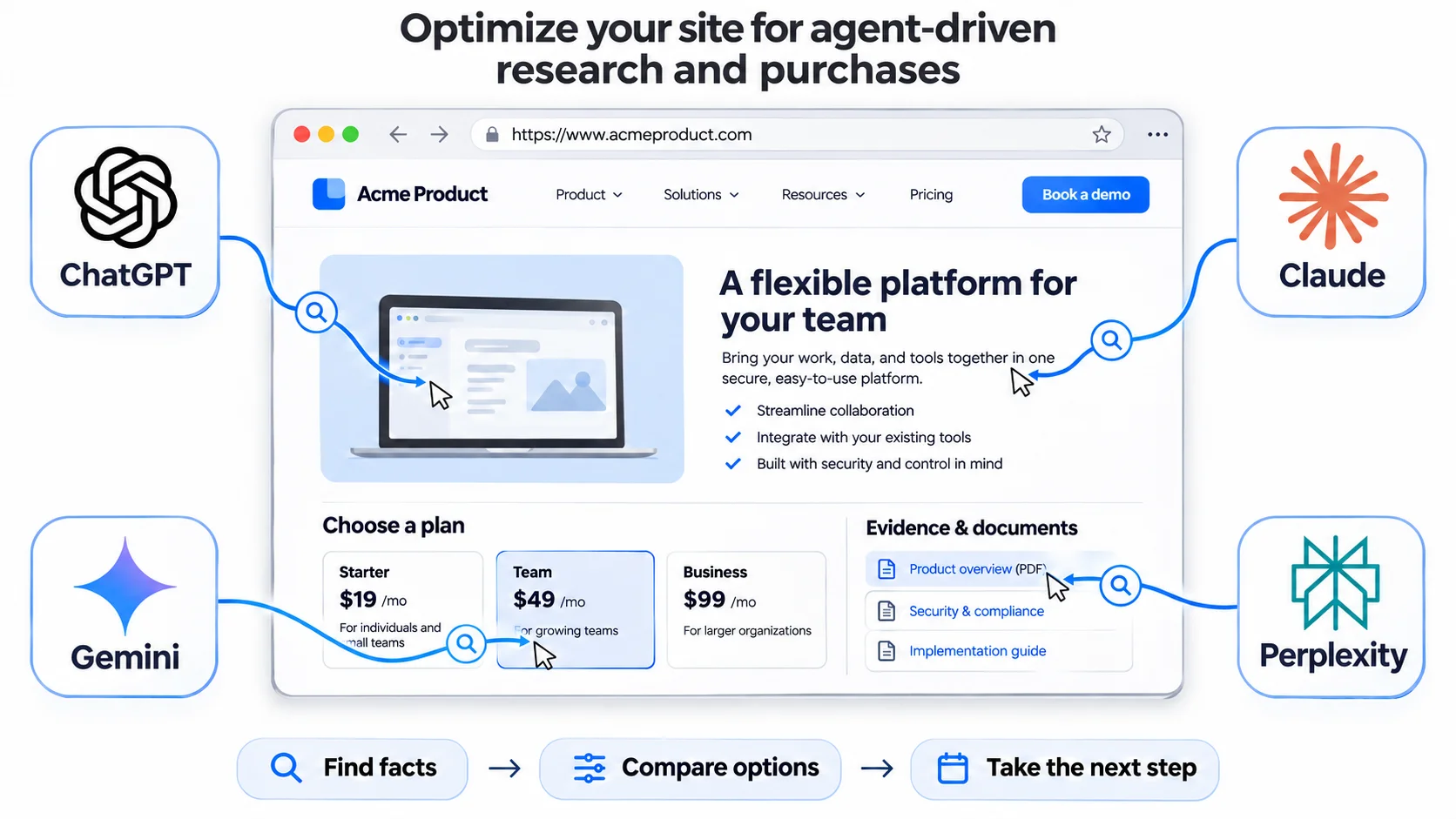
Optimize your site for agent-driven research and purchases
When a buyer asks an AI agent to compare products, your website supplies the facts behind its answer. Help it understand your offer, check whether it fits and carry the buyer’s requirements into the next step. This guide draws on tests with ChatGPT, Claude and Gemini visiting Tailor’s site.
Unclear pricing and requirements led agents to give wrong buying advice.
Bring the evidence together
A focused product assessment helped Claude answer the same questions with fewer page reads.
Keep the buyer’s context
A readable demo agenda preserved requirements that the booking page had dropped.
Illustrative buyer journey. The sample product and prices are fictional; agent logos show examples, not measured results for every client. View full size
What matters
Help agents decide whether your product fits
Make product facts easier to find, understand and act on. Then test whether agents reach the right conclusion, including when a product does not fit.
01 / Discovery
Find a relevant product
Appear in an open-ended search for options.
Brand discovery unmeasured
02 / Evaluation
Decide whether it fits
Check requirements, costs and supporting evidence.
Main focus of these tests
03 / Action
Take the next step
Carry requirements into a demo, quote or purchase.
Handoff checked; completion unmeasured
Start with clear facts and relevant evidenceA buyer assessment is a product evaluation built around someone’s requirements, with links to the sources behind each answer.
Our tests focused on agents evaluating a supplied website. More brand recommendations, qualified leads and sales remain goals to measure.
The buyer’s job
Where AI agents got it right and wrong
We gave public agents realistic buyer questions about Tailor. These simulated visits exposed problems a prospect could encounter. No purchases or bookings were made.
01
Can I measure Shopify purchases before I commit?
A Shopify growth team needs purchase and revenue measurement, GA4 compatibility and approval before changes go live.
Claude answered the same requirements with 3 page reads instead of 6. ChatGPT already performed well. Gemini still added claims the sources did not support.
See the before-and-after journey and details
A successful answer: Explain fit, native setup and how to verify a conversion. Separate product capabilities from plan eligibility and unresolved commercial terms.
Earlier flow
Homepage
integration and setup pages
pricing
assembled recommendation
With the improvement
Supplied assessment
complete supporting sources
qualified recommendation
Claude retained 10/10 rubric coverage with 6 → 3 visible page reads versus current-page browsing. ChatGPT scored 10/10 on both current pages and the assessment. Gemini covered more of the task with the assessment, but added unsupported claims.
The clearest gain was less evidence gathering for an already capable reader. More complete answers did not guarantee factual reliability for every agent.
02
Will this work on my free Webflow plan?
A marketer on Webflow Starter wants to personalize Google Ads traffic, including CMS pages with animations.
The first assessment missed an installation blocker. After we made custom-code access explicit, all three agents identified the blocker in fresh tests.
See the before-and-after journey and details
A successful answer: Identify the documented custom-code installation blocker, explain CMS targeting and animation caveats, and avoid proposing an experiment that cannot be installed.
Earlier flow
Browse separate sources
reconcile a “potential fit” assessment with the installation blocker
With the improvement
Specify custom-code access
expose the blocker
withhold the example experiment
Claude spotted the original assessment mismatch. After the revision, fresh tests in all three clients identified the installation blocker and distinguished the GA4 capabilities. Gemini still gave an unverified plan example and a shorter verification procedure.
Success can mean telling a buyer to resolve a prerequisite before proceeding. The initial Claude comparison also retained 10/10 coverage with 10 → 1 page reads; the blocker revision was a later test.
03
Does the plan fit my traffic and budget?
A Shopify buyer asks about 50,000 tailored visitors and a $250 monthly budget. Follow-ups change traffic, budgets and tier boundaries.
Clearer pricing rules helped agents recover wrong cost calculations. Some mistakes about which features a plan included remained.
See the before-and-after journey and details
A successful answer: Apply the published allowance and overage tiers correctly, then check feature eligibility separately. Keep any unquoted plan price unknown.
Earlier flow
Read a pricing table
miss an overage or choose the wrong tier
give an unreliable budget answer
With the improvement
Read explicit tier rules and visible inclusions
calculate conditional cost
check remaining eligibility
ChatGPT initially proposed hypothetical $500 pricing; the revised assessment recovered the conditional $1,250 calculation. Gemini later recovered arithmetic at 75,000, 100,000 and 150,000 visitors after source clarifications, while some entitlement errors remained.
Clearer source text corrected specific decision errors. A later Claude comparison used 5 → 2 page reads with the same material constraints. These are historical test prices, not current quotes.
Observed outcomes
What improved in our tests
Claude and ChatGPT already answered the original site’s research questions well. The assessment’s clearest advantage for Claude was preserving the detail with fewer visible page reads.
Shopify research
6→3
Browsing
Assessment
Pages Claude opened
Current homepage → linked buyer assessment
Webflow research
10→1
Browsing
Assessment
Pages Claude opened
Current homepage → linked buyer assessment
Shopify pricing holdout
5→2
Browsing
Assessment
Pages Claude opened
Existing pricing page → linked buyer assessment
Three comparisons against current ordinary pages, not the frozen historical site. These counts measure visible page reads, not tokens, latency, unique requests or cost savings.
Our approach to customer pilots
How we could improve your website for AI buyers
You can find problems before you have much AI traffic. Use realistic buyer tasks to see where agents struggle, then test whether changes help. This is our proposed approach for exploratory customer pilots, based on results from Tailor’s site.
Test your site with public agents
Ask questions your buyers ask about fit, pricing and setup. Keep the original site as your baseline.
Find where agents get confused
Review missed facts, wrong conclusions and points where the agent cannot proceed.
Generate and publish targeted improvements
Clarify source pages and build the comparisons, FAQs or buyer assessments that address those failures.
Check whether the changes work
Repeat matched tasks in fresh chats, then vary the requirements. Score answer quality and next-step completion; track real leads and sales separately.
Which parts of the site should you improve?
Clarify product facts
Publish capabilities, pricing rules and exclusions in plain words.
Example & evidence
SaaS plan eligibility. Retail compatibility and delivery. Service scope and availability.
Assemble the evidence
Bring the sources for a buying decision together, including poor-fit conditions.
Example & evidence
Integration requirements, product comparisons or service eligibility.
Make essentials readable
Put decision-critical content in initial HTML. Add tools where they help.
Example & evidence
Agents differed in JavaScript support and native tool discovery.
Carry context forward
Preserve requirements in the next step.
Example & evidence
Our agenda recovered missing context. Demo, quote and cart completion still need testing.
Test before traffic arrives
Simulate buyer visits, fix failures and repeat with unfamiliar tasks.
Example & evidence
Keep the original baseline. Measure real visitor outcomes separately as traffic grows.
A useful customer pilot begins with approved product facts and a handful of buying tasks. Judge whether the agent reaches the right conclusion with the necessary caveats. Count tool usage and page reads as supporting evidence, alongside answer quality and successful handoffs.
What we would keep
What worked, and what didn’t
These decisions combine unequal exploratory samples. They are not a randomized ranking of technologies.
Accurate ordinary HTMLKeep as the foundation
The original site already supported strong Claude and ChatGPT answers. Clarified GA4 facts and pricing prose improved specific answers; give content corrections credit separately from interface changes.
Sourced buyer assessmentStrongest added research feature
Combined requirements, full evidence and explicit unknowns. Preserved Claude’s coverage with fewer page reads; revised content recovered a ChatGPT pricing error. Gemini remained variable.
Short search excerpts and general guidesUseful with deeper evidence
Orientation was useful, but early excerpts omitted prerequisites and late verification steps. Full relevant source pages were needed for detailed setup questions.
Readable HTTP tools and exact URLsKeep as optional entry points
Claude discovered a buying-brief HTTP endpoint from the current homepage. Identical assessment HTML worked differently by client and URL; ordinary URLs were not universally better than API URLs.
llms.txt and alternate textNo consistent additional win
A compact index was readable in some trials but did not reliably improve outcomes, so we did not promote it. Earlier full-text truncation lost facts; targeted Markdown helped some guided reads.
Generated site Q&ANeeds stronger grounding
Earlier exploratory answers omitted available pricing/setup details and added unsupported guidance. This research round did not include a new matched Q&A comparison.
MCP and WebMCPSupport where connected
An earlier guided Claude trial made real MCP calls. No successful native MCP or WebMCP call was demonstrated in the November 2 round. HTTP use does not establish native protocol adoption.
JavaScript-only factsUse initial HTML for essentials
In 10 separate rendering trials, Gemini twice missed JavaScript-added facts and returned the initial price. Claude recovered values by fetching script and JSON; browser controls rendered correctly.
What this means for recommendations
Can a better website lead to more AI recommendations and sales?
The tests demonstrated more efficient research for Claude and recovery of specific mistakes across clients. A buyer who gets the right prerequisites and costs can make a more informed choice, including deciding that Tailor does not fit.
Observed
Improved access to evidence, fewer reads in selected comparisons, and specific answer corrections.
Plausible next effect
A better-grounded recommendation for a suitable buyer in a future visit. We have not measured its frequency.
Needs a separate test
More unaided recommendations or citations, qualified demos and completed purchases.
These visits do not establish that an assistant remembers the site or learns to recommend it in later conversations. Testing that outcome requires repeated fresh buying prompts, both with and without the brand named, and a stable comparison group.
How we tested
How we tested ChatGPT, Claude and Gemini
Tests ran November 2–3, 2026. This guide was updated November 10. The November 2 round contained 44 fresh research trials, including failed and incomplete runs. The primary comparison was 18 chats: three public clients × two buyer stories × three starting conditions.
44 fresh research trials18 primary chats3 public clients10 separate rendering trials
See the five test types and their controls
Original website before changes
We preserved the pre-session site, including its existing llms.txt and Markdown. Agents started at its homepage. This was the baseline before our agent-focused improvements.
Current homepage, no tool hints
Agents received the same buyer tasks and the updated homepage. They had to find useful pages or tools themselves. This tested browsing and on-site discovery, not unprompted brand discovery in search.
Direct link to a buyer assessment
Agents received a task-specific HTML assessment with complete sources. This tested whether the resource helped once reached. It did not test whether they would find it unaided.
New buyer requirements and page formats
Follow-ups changed traffic volumes, budgets and requirements. We also compared a compact index and byte-identical HTML at ordinary and API URLs. Failed retrievals remained in the record.
Rendering and handoff checks
Ten separate trials tested JavaScript-added facts against browser controls. The November 3 agenda check was a guided visit and a same-session recovery, outside the 44-trial research round.
Full answer scores and remaining failures
How completely agents answered the questions, out of 10
One reviewer scored fit, setup, verification, constraints, and pricing/unknowns from 0 to 2 each. The reviewer knew which version was being tested. These scores describe coverage, not success percentages. There was one primary run per cell.
Historical homepage vs. current homepage vs. guided assessment
Agent
Buyer task
Original site
Current site
Assessment
Claude
Shopify
10
10
10
Claude
Webflow
10
10
10
ChatGPT
Shopify
9
10
10
ChatGPT
Webflow
9
9
10
Gemini
Shopify
3*
Error
9*
Gemini
Webflow
3*
3*
4*
* Material unsupported claims or source violations. Gemini’s 9/10 Shopify assessment covered more questions but invented import scope and missed published traffic limits. It was not a clean success. “Error” is a retained failed run, not a zero score.
GA4 coverage was assessed separately because the facts were clarified after the historical snapshot. Claude and ChatGPT recovered those facts from current sources. That gain belongs to corrected content. A high coverage score also does not certify every statement: Claude’s Shopify assessment called self-service import unsupported when it was only unestablished.
Pricing recoveries and failures that remained
After we explained overage tiers in prose, Gemini calculated the conditional costs correctly at 75,000 and 100,000 visitors. Visible inclusion labels were followed by correct arithmetic at 100,000 and 150,000 visitors, including a new tier boundary.
It still falsely excluded GA4 export from Basic in the 150,000-visitor answer. A directed follow-up read the exact row correctly and retracted the claim. The original answer remains a failure. Clear source text improves the evidence available; it cannot guarantee that a model uses it correctly.
One ChatGPT transport comparison stalled. A subsequent control showed an anonymous-chat verification block. We retained the run as incomplete and did not attribute the stall to the website’s URL format.
Scope and evidence
What we haven’t proven yet
One site, small samples, unblinded scoring, possible retrieval caches and changing client behavior limit the conclusions. Preview hosts changed in some retests, so content improvements and retrieval variability cannot always be separated.
Fresh conversations and varied arm order reduced some carryover. Claude used its visible Opus 5.5 Medium setting; ChatGPT used a signed-out public session; Gemini used its signed-in public client with prompts excluding memory and connectors. ChatGPT and Gemini model versions were not independently verified.
Research was read-only. We did not measure conversion lift, completed purchases, booking completion or search-ranking improvement. Rendering fixtures were noindex and did not run the Tailor SDK. Pilots, client health controls and targeted diagnostics are retained separately from the research count.
The linked tools and guides reflect the current product. Scores and price examples above describe the dated tests. The next useful validation is a customer-site pilot with its own approved facts, unfamiliar buyer tasks and measured qualified handoffs.
Exploratory customer pilots
How do AI agents evaluate your site?
Discuss the buyer questions worth testing, where your site could improve and how to measure the result. Pilot scope and availability are agreed together.