
Every team has its own agent now, and the marketing leader can see less than before.
"Every silo is running its own agent, and it's making the chaos worse."
A marketing leader told me that about his last company. He's not a skeptic. He wanted more AI, not less. His problem is he got it.
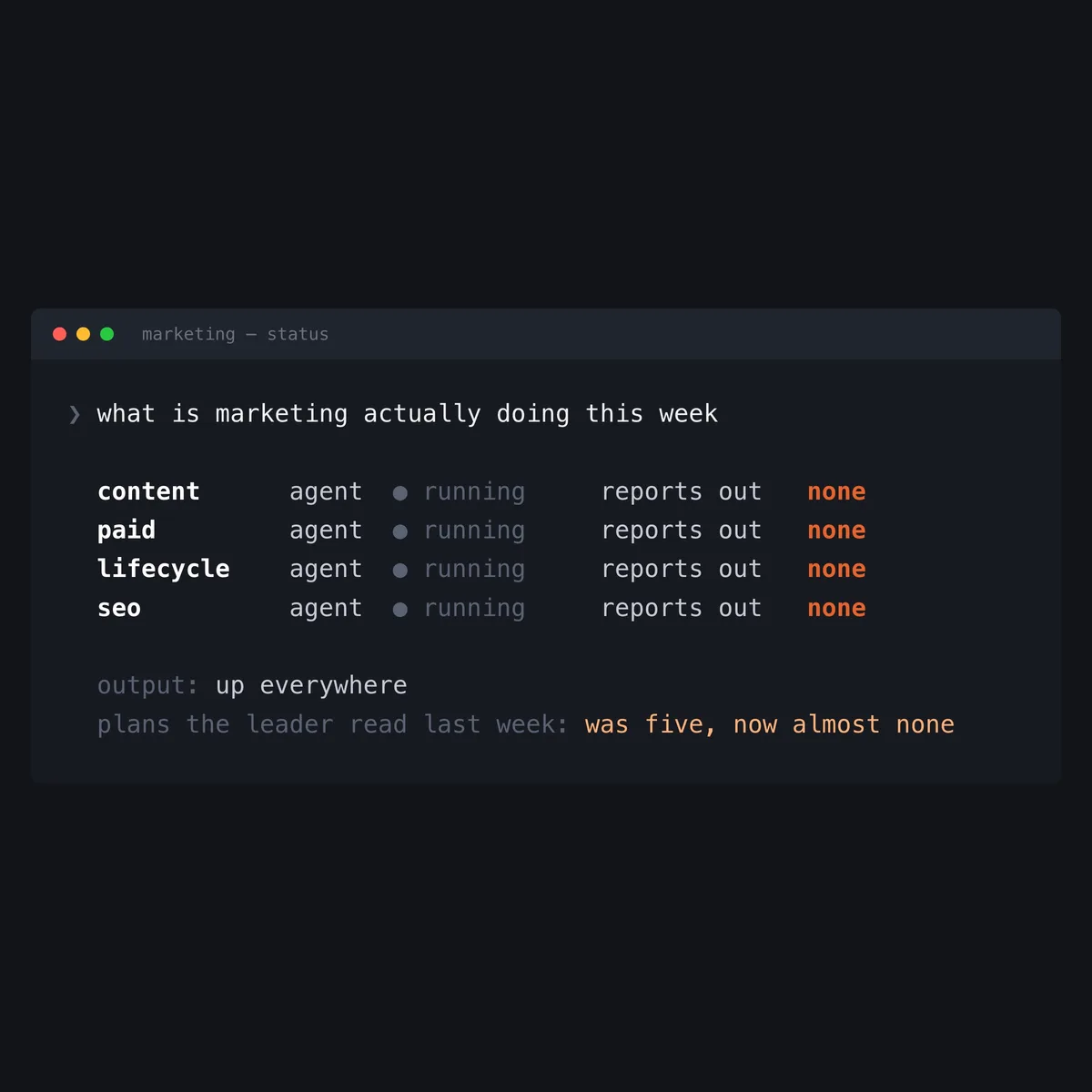
Content had an agent. Paid had one. Lifecycle had one. Output went up everywhere. And the guy whose job is knowing what marketing is doing went from reading five plans a week to reading almost nothing.
He doesn't want another dashboard. He doesn't want to call a status meeting either, because he finally got his team automating and interrupting that feels like the wrong move.
I didn't have a good answer for him on the call.
What I think happened is simpler than it looks. Automating a workflow is quick now. Automating one well is not. Anyone can get a rough loop working in an afternoon. The time all goes into the last 10%, the integrations and the edge cases and making it useful to everyone else it touches.
Nobody building their own little tool wants to spend three weeks there. And they don't have to. It already works for them.
Reporting out was always in that last 10%. So the work gets automated and the visibility doesn't. It's nobody's fault. The loop does exactly what its builder needed.
Engineering has been chewing on this for twenty years. Tickets, CI, code review are all the same thing. Work that reports itself. Marketing never had to build that in.
So how does a marketing leader get back to seeing where the bottlenecks are, when half their org is building agents? I don't have this one. If you've solved a piece of it I'd like to hear it.
The bit I keep coming back to: the person who automated the workflow isn't hiding anything. It works. They have no reason to notice nobody else can see it.
Which means asking for status treats it as a willingness problem when it's a plumbing problem.
Written by

Greg Bayer
CEO & Co-founder