
Big companies stopped buying smaller ones because they think they can build it now.
"Big companies have stopped buying smaller ones. They all think they can just build it now."
A PE guy told me that this week. He's not thrilled, obviously, it's his business. He's also convinced they're wrong.
I think I know how this plays out, and it isn't about whether they can build the thing.
AI made the expensive parts of software cheap. Engineering hours, QA, the build itself. Every one of those had a line item somebody owned and defended in a planning meeting, and every one got hit.
Taste has a line item too. It's product and design headcount. Internal tools just never get any of it. You get an engineer, or now an agent, and no PM, no designer, and if the company isn't a strong software company to begin with, nobody on the project has ever taken something from working to actually used.
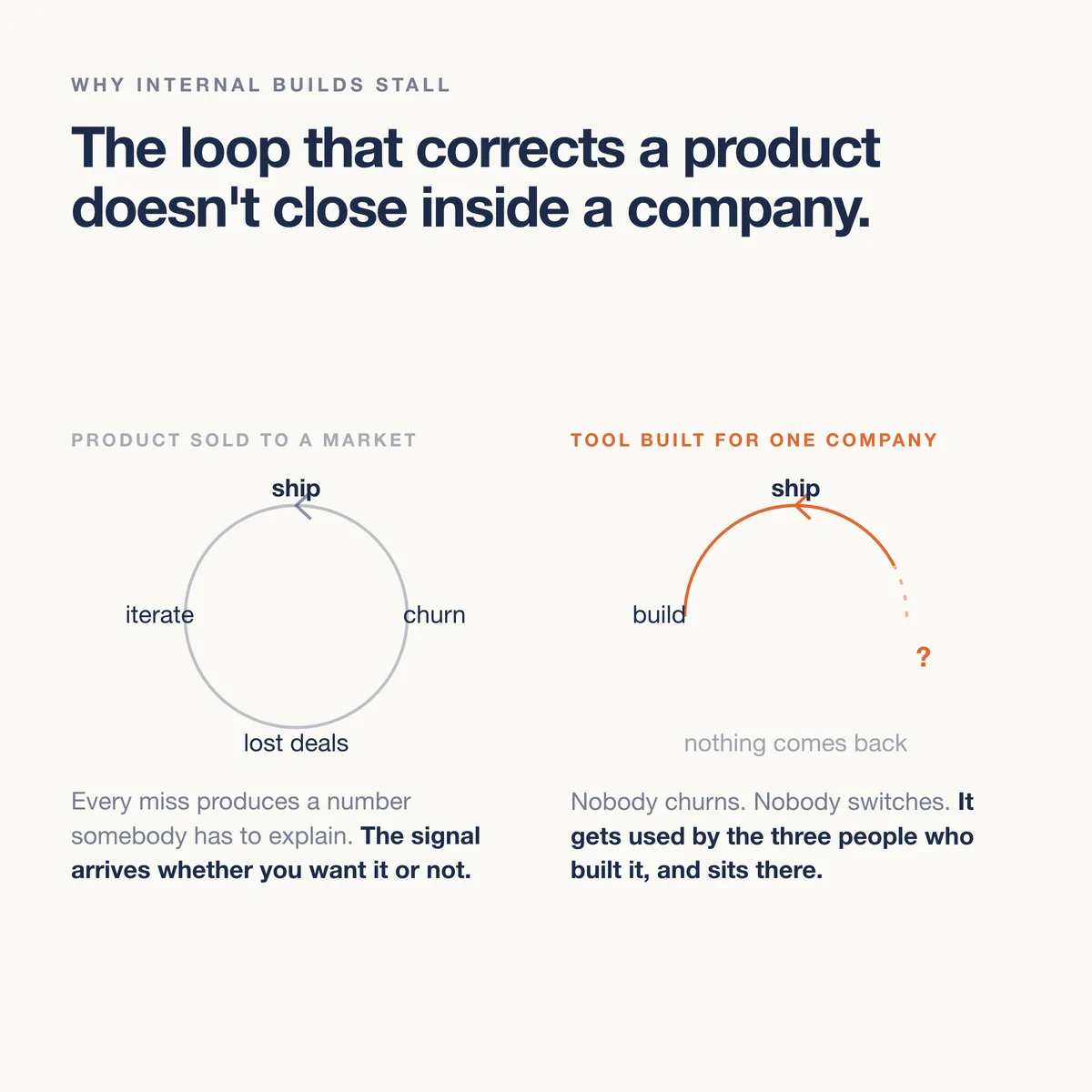
Which is the part I think people are missing. An internal tool still has to find product-market fit. Market of one company, sure, but it has to earn adoption in there the same way anything else does, through a lot of ugly iteration with people who aren't obligated to use it.
And nothing tells you when you've failed. No churn, no lost deal, no competitor taking the account. The tool gets used by the three people who built it and sits there costing maintenance.
So I think we end up with thousands of internal tools that are 80 or 90 percent of the solution and never go the rest of the way. Fine for narrow, well-specified jobs, and that part is real, I'm not waving it away because it's inconvenient for me. But it doesn't replace a deep workflow, and the deep workflows are where the value stays. It's why we stopped arguing capability in sales meetings and spend the hour on the workflow instead.
The only thing I don't know is how long before this is obvious. Companies can run a long time on a build decision that isn't working, because nobody wants to be the one who says the internal version is worse.
The tell I'd watch for: an internal tool that shipped and then stopped getting updated. That's usually not a resourcing problem. It's usually nobody being sure what the next version should be, which is the same thing as not having found fit.
If you're making one of these build-or-buy calls right now I'd like to hear how you're thinking about it. Especially if you decided to build.
Written by

Greg Bayer
CEO & Co-founder