
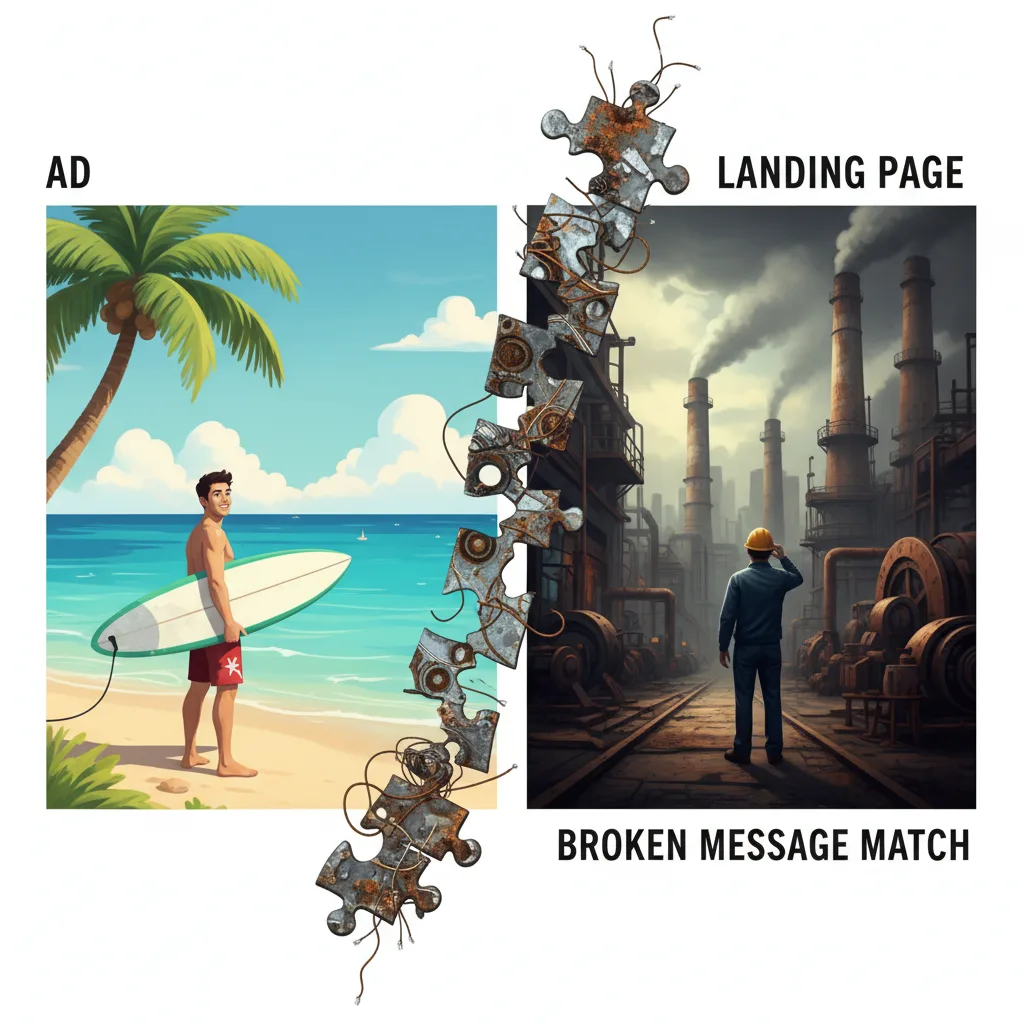
Most ad dollars don't die in the ad. They die on the landing page.
The Message Match Crisis
Ads aren't the broken part. Message match is. The same pattern plays out constantly: advertisers build hyper-personalized ads tailored to specific audiences, intents, and timing, then send all that targeted traffic to the same generic landing page.
This disconnect creates a jarring experience for users. Imagine clicking on an ad that speaks directly to your specific pain point, only to land on a page that feels completely irrelevant to what you just engaged with. The relevance immediately drops, friction increases exponentially, and return on ad spend (ROAS) vanishes faster than you can analyze the numbers.
The Real Growth Opportunity for 2025
The opportunity for 2025 is turning static landing pages into adaptive experiences that hold the relevance your ads established. More creative and more budget both help, but neither fixes this.
This transformation has three parts:
Context Detection
: Modern landing pages should automatically detect and respond to campaign context, including UTM parameters, keywords, geographic location, and device type. This data provides the foundation for creating truly relevant experiences.
Dynamic Tailoring
: Once context is detected, every element of the page (headlines, social proof, images, and calls-to-action) should adapt to match the specific message and intent that drove the click. That's more than a headline swap. The whole page should read as a continuation of the ad.
Rapid Validation
: A/B test those personalized experiences quickly, so you know what works instead of guessing.
The Compound Effect of Message Match
When every click receives exactly the message it came for, the results compound in powerful ways. Higher conversion rates are just the beginning. Clean, consistent signals help advertising algorithms learn faster and optimize more effectively. This creates a flywheel. Better data sharpens targeting, which lifts results and feeds back even more signal.
Speed compounds the advantage. Most teams spend weeks planning personalization campaigns. With adaptive landing pages, you can launch and optimize in hours.
Making Personalization the Default
This is why we built Tailor AI: to make sophisticated personalization accessible and immediate rather than a six-week development sprint. Our early partners are consistently seeing double-digit conversion lifts while dramatically reducing time-to-market for new campaigns.
The technology to close the gap between personalized ads and personalized landing pages exists today.
If you're curious about whether your current landing pages have message-match gaps that could be costing you conversions, we'd be happy to take a look and share our findings.
Read Next

Written by

Greg Bayer
CEO & Co-founder